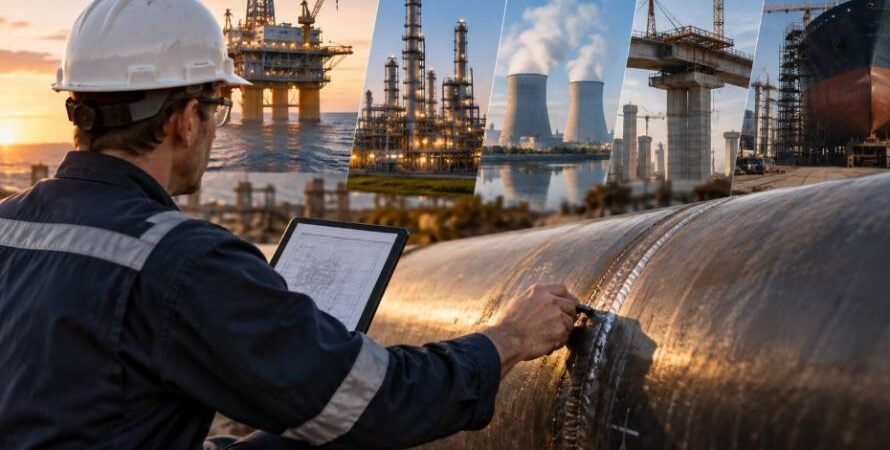
I started noticing that welding inspection opens doors that are easy to miss when you think of welding as only a hands-on trade. Once someone understands how welds are made, what can go wrong, and how quality is documented, that knowledge can transfer into inspection work across very different industries.
I also found that the career is broader than standing beside a fabrication table and checking finished welds. Inspectors may work around structural steel, pressure equipment, pipelines, manufacturing plants, ships, or specialized components. That variety makes welding inspection career opportunities worth exploring for experienced welders who want a new challenge without leaving the industry behind.
What Welding Inspectors Actually Do
A welding inspector is responsible for much more than spotting an ugly bead. The job can involve reviewing drawings, specifications, welding procedures, welder qualifications, materials, joint preparation, preheat, fit-up, welding parameters, and final weld condition. Inspectors also document findings and help determine whether work meets the applicable code, specification, or project requirement.
Visual inspection is often central, but some positions also involve nondestructive testing, measurement, documentation review, and coordination with welding supervisors, engineers, fabricators, and clients. Inspectors need enough welding knowledge to recognize why a discontinuity matters, not simply notice that something looks unusual.
That practical background can be valuable. Someone who has spent years understanding arc behavior, joint fit-up, distortion, consumables, and welding positions often brings useful judgment to inspection work. For welders considering the transition, how to build experience as a professional welder can become part of a longer career strategy rather than a short-term goal.
Industries Where Inspection Skills Matter

Construction and structural fabrication provide a major path for inspectors. Projects involving buildings, bridges, and industrial structures require careful control of weld quality and documentation. The work may shift between shops and active job sites.
Manufacturing and heavy fabrication offer another route. Inspectors may work with machinery, pressure-related equipment, agricultural equipment, transportation components, or large industrial assemblies. Shop-based positions can provide a more predictable environment, while field assignments may bring more variety.
Energy-related industries can demand deeper specialization. Oil and gas, power generation, pipelines, refineries, and process facilities rely on inspection because weld failures can have serious safety and operational consequences. Familiarity with applicable codes, materials, welding procedures, and inspection methods becomes especially important in these settings.
Shipbuilding, aerospace, defense, and other specialized manufacturing environments can also create opportunities. The common thread is reliable workmanship, traceable records, and inspectors who understand the consequences of accepting or rejecting welds.
Certifications Can Broaden the Career Path
The Certified Welding Inspector, or CWI, credential is one of the most recognized qualifications in the field. Eligibility depends on a combination of education and welding experience, and the certification process tests practical inspection knowledge as well as understanding of welding standards and related requirements.
A CWI credential can strengthen a candidate’s position, but certification alone does not replace field judgment. Employers can still value experience with specific welding processes, materials, codes, documentation systems, and project environments.
Nondestructive testing can provide another layer of career mobility. Skills in methods such as ultrasonic, magnetic particle, liquid penetrant, or radiographic testing can complement visual welding inspection. With experience and additional qualifications, professionals may move toward senior inspection, NDT, quality assurance, quality control, supervision, or technical positions.
What Employers Tend to Value
Strong inspectors combine technical knowledge with practical habits. They need to read drawings and specifications carefully, recognize weld discontinuities, take accurate measurements, maintain organized records, and communicate problems without creating unnecessary conflict.
Attention to detail matters, but so does consistency. An inspector has to apply requirements fairly even when production pressure is high. Clear reporting is equally important because inspection records may later become evidence that work met contractual, code, or regulatory requirements.
Field readiness matters too. Some jobs involve travel, changing work environments, weather exposure, shutdown schedules, or coordination with multiple contractors. Anyone moving toward mobile or field inspection should understand the hazards surrounding the work. That is where risk assessment before mobile welding jobs can reinforce a broader safety mindset, especially when inspection and welding activities overlap.
Where the Career Can Go Next

An inspection position does not have to define the rest of the career. An inspector who develops strong code knowledge and industry experience may take on more complex projects or move into senior inspection responsibilities. Others may specialize in NDT, welding quality systems, pressure equipment, pipelines, or particular fabrication sectors.
Experience can also lead toward QA/QC coordination, inspection management, training, auditing, or consulting. In specialized environments, additional industry credentials can help professionals qualify for work involving particular equipment or inspection responsibilities.
Pay varies substantially by location, certification, industry, travel requirements, overtime, and experience. Entry-level roles may begin around the lower end of the inspection market, while experienced CWIs and specialists can command considerably more. High-demand field assignments, overtime, and advanced technical credentials can push compensation well beyond ordinary shop-based positions.
Frequently Asked Questions
1. Is welding experience required to become a welding inspector?
Requirements vary by certification and employer. Welding experience is highly useful because inspectors need to understand welding processes, joint preparation, defects, and practical production conditions.
2. Is a CWI certification necessary for every welding inspection job?
No. Some positions have different requirements, while employers may strongly prefer or require CWI certification. Code and project requirements also matter.
3. Can welding inspectors work outside construction?
Yes. Opportunities exist in manufacturing, fabrication, energy, pipelines, shipbuilding, aerospace, defense, transportation, and other industrial environments.
4. Can welding inspection lead to management roles?
It can. With experience, code knowledge, communication skills, and additional qualifications, inspectors can move into senior inspection, QA/QC, supervision, auditing, consulting, or management.
The Career Value of Seeing Welding From Both Sides
Welding inspection can be a smart progression for someone who enjoys the technical side of fabrication but wants a different daily working role. The strongest professionals understand that quality is not created during the final inspection alone, especially on major projects.
It develops through proper materials, qualified procedures, competent welders, sound preparation, controlled processes, accurate inspection, and honest documentation. Learning to see that entire chain can make an experienced welding professional far more versatile.
A good inspection career is ultimately built on credibility. When people trust your judgment, records, and understanding of the work, opportunities tend to follow. That reputation can carry across projects, industries, and increasingly responsible roles.