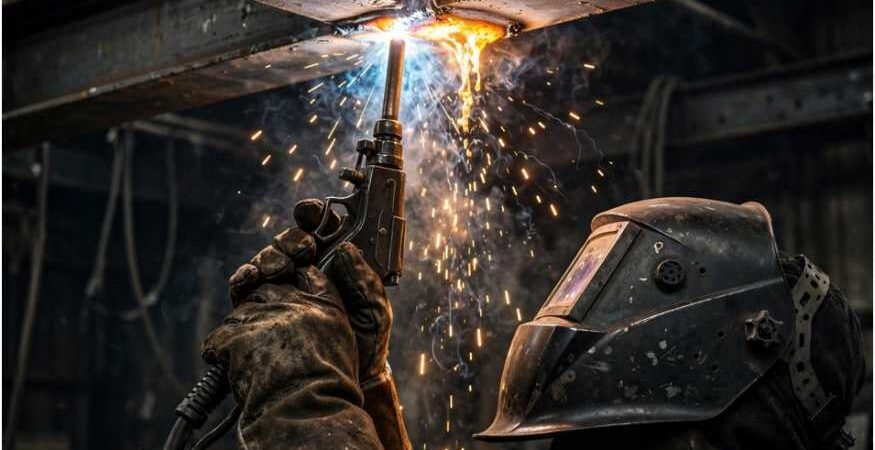
Overhead welding punishes bad gun angles faster than any other position in the shop. If you are debating mig welding overhead position push or pull, here is the direct answer from decades under the helmet: use a near-neutral 90-degree angle with a minimal 5 to 10-degree push or pull depending strictly on wire type and base metal thickness.
Leaning too hard into an aggressive angle lets gravity pull your molten puddle down onto your nozzle, your leather sleeves, and your shop floor. Managing the overhead puddle requires balancing travel angle, arc force, and gun manipulation.
The Physics of Overhead MIG: Arc Force vs. Gravity
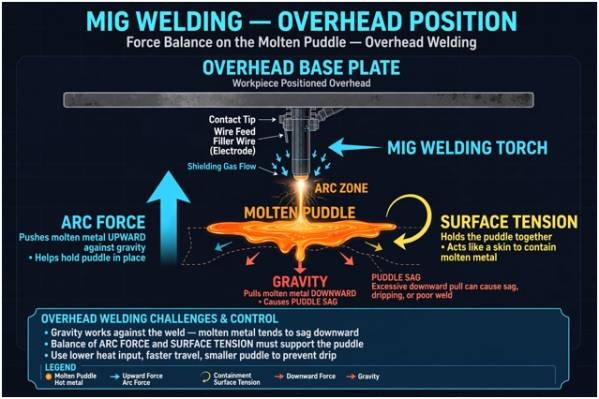
Molten metal stays in an overhead joint through surface tension, puddle freezing rate, and the directional force of the plasma arc stream. When working in flat positions, gravity assists puddle wetting. Overhead, gravity works against your joint geometry constantly.
[ Overhead Base Plate ]
▲ ▲
Arc Force │ │ Surface Tension
│ │
[ Molten Puddle ]
│
▼ Gravity (Puddle Sag)
The American Welding Society (AWS) outlines the 4G groove and 4F fillet specifications as high-skill positions because puddle volume must remain compact. An aggressive travel angle directs arc energy horizontally rather than into the root. That loss of upward pressure lets molten steel drop out of the joint before freezing.
Similar puddle-freezing dynamics apply when you learn how to stick weld vertical up 7018, where arc control directly counters molten drop. Keeping your MIG gun square transfers raw arc force upward, pinning the puddle flat against the root face.
Push vs. Pull Overhead Dynamics Compared
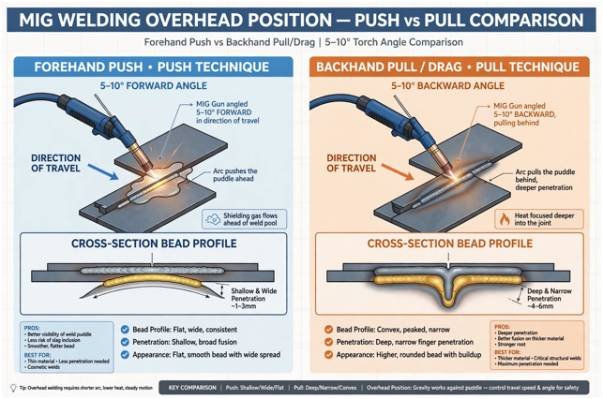
Choosing forehand (push) or backhand (pull) overhead depends on material gauge and whether your wire produces slag. Both approaches have specific roles on the shop floor.
| Parameter | Push (Forehand) | Pull / Drag (Backhand) |
| Optimal Angle | 5° to 10° forward | 5° to 10° backward |
| Penetration Profile | Shallow to medium, wide base | Deep, narrow finger penetration |
| Bead Crown | Flat, flush profile | Convex, built-up profile |
| Ideal Materials | Thin sheet metal, stainless, aluminum | Thick plate carbon steel |
| Wire Compatibility | Solid GMAW wire ($ER70S-6$) | FCAW flux-cored, metal-cored, solid wire |
| Slag Risk | High if running FCAW (traps slag) | Zero slag entrapment |
When to Push Overhead (Forehand)
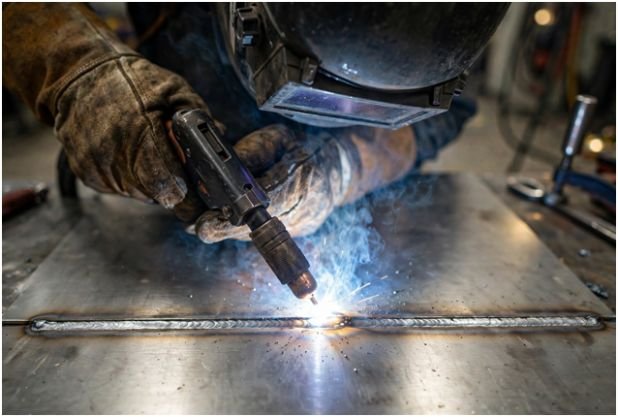
Pushing involves pointing the welding wire forward in the direction of travel. This orientation spreads the arc energy over a broader surface area, generating a flatter bead with minimal crown buildup.
Pushing is ideal for sheet metal under 1/8-inch thickness, aluminum alloys, and thin-gauge stainless steel. Aluminum requires a push technique under shielding gas to clear oxides ahead of the arc. Avoid pushing if you run flux-cored wire; pushing flux-cored wire rolls the molten puddle over unburned flux, causing slag inclusions and porosity.
When to Pull Overhead (Backhand)
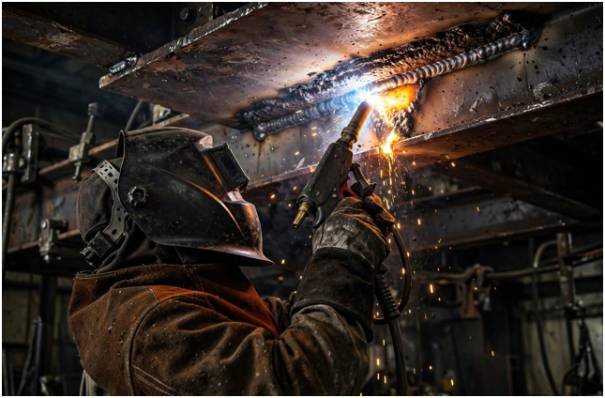
Pulling involves dragging the torch with the nozzle pointing back at the completed weld pool. The arc stays focused entirely on the leading edge of the puddle, driving thermal energy deep into the root pass.
Dragging works best on structural steel plates 1/4-inch and thicker using solid wire, and it is mandatory for gas-shielded or self-shielded flux-cored arc welding ($FCAW$). Following standard guidelines from Lincoln Electric, dragging keeps slag trailing behind the active arc column, ensuring zero slag entrapment. The trade-off is a taller, more convex bead profile that requires disciplined travel speed to prevent crowning.
Dialing in Voltage, Stick-Out, and Travel Angle
Successful overhead MIG joints rely on exact mechanical settings. Small errors in electrical stick-out or travel angle disrupt arc stability immediately.
| Parameter | Recommended Setting | Workshop Impact |
| Gun Work Angle | 90° split directly in the joint corner | Equal leg lengths on fillet joints |
| Gun Travel Angle | 5° to 10° maximum (Push or Drag) | Retains upward plasma force to stop sag |
| Electrical Stick-Out | 3/8-inch (keep strictly under 1/2-inch) | Prevents amperage drops and wire stubbing |
| Arc Voltage | Same or 0.5V lower than flat position | Maintains puddle freeze control |
| Shielding Gas Flow | 25 to 30 CFH ($75/25\ Ar/CO_2$) | Prevents draft turbulence overhead |
The 90-Degree Neutral Baseline
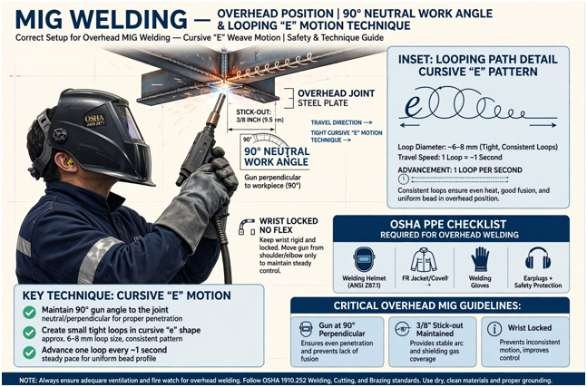
When running overhead beads, keep the torch perpendicular to the joint. A pure 90-degree work angle divides arc energy evenly between both workpieces.
Manufacturer data from Miller Electric confirms that exceeding a 10-degree travel angle in overhead positions causes severe undercut along the top plate toe. Keep your wrist locked. Tilting your wrist mid-pass directs the arc outward, causing cold lap along the upper toe and excessive reinforcement along the bottom.
The Fast Looping Technique
Do not weave widely overhead. A wide weave holds too much molten metal in one place, overwhelming surface tension.
Instead, maintain a tight, continuous looping motion—similar to miniature cursive “e” or tight “u” shapes—advancing at roughly one loop per second. This motion washes the puddle up onto both plates and steps forward before thermal mass drops out.
Always wear heavy-duty leathers, a fire-resistant cape, and full personal protective gear meeting OSHA Eye and Face Protection Standards to shield against dripping spatter.
Frequently Asked Questions
1. Can you push flux-cored wire in the overhead position?
No, pushing flux-cored wire traps freezing slag inside the weld deposit, so you must always pull or drag flux wire.
2. Why does my overhead MIG bead sag in the middle?
Your puddle is sagging because your travel speed is too slow, your travel angle exceeds 10 degrees, or your voltage is set too high for your wire feed speed.
3. What is the ideal shielding gas for overhead MIG on carbon steel?
A standard blend of 75% Argon and 25% Carbon Dioxide ($C25$) provides the best puddle control and arc stability for overhead steel welds.
4. Should I drop my voltage settings when moving from flat to overhead?
Keep your voltage identical or reduce it by no more than 0.5 to 1.0 volt to maintain arc force while preventing an oversized, unmanageable puddle.
Lock Your Wrists and Own the Ceiling
Overhead MIG welding is not about guessing between extreme angles; it is about maintaining a tight, 90-degree neutral stance with a strict 5 to 10-degree push on sheet metal or drag on heavy plate.
Keep your stick-out at 3/8-inch, run your travel motion at a consistent one-beat loop, and let arc force hold your puddle where it belongs. Grab some scrap plate, set your machine to standard flat parameters, and run a test coupon at dead 90 degrees to see the difference firsthand.