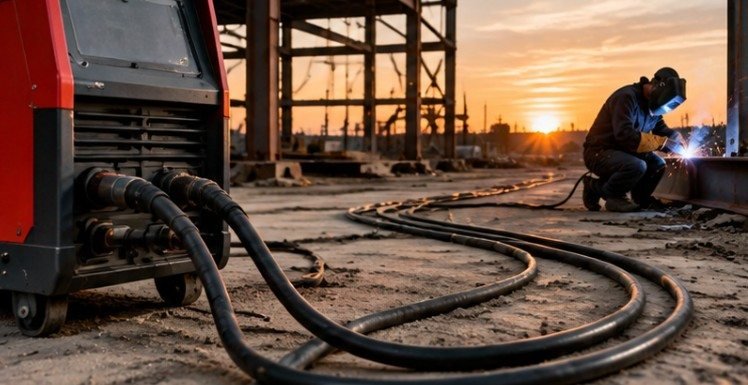
A welding machine can deliver hundreds of amps, but that power means little if the cable carrying it cannot handle the distance. The wrong welding cable size for long leads can cause voltage drop, weak arcs, excessive heat, and premature cable failure—even when the welder itself is working perfectly.
Many welders focus on machine amperage but overlook the fact that the total cable length includes both the electrode lead and the work lead. A 100-foot setup is not a 100-foot circuit; the current must travel out and return, creating a much longer electrical path.
Choosing the correct cable gauge is less about buying the biggest cable available and more about balancing amperage, duty cycle, length, and job conditions.
Why Long Welding Leads Require Larger Cable Sizes
Welding cables are flexible conductors designed to carry high current at relatively low voltage. However, every conductor has electrical resistance. As the cable gets longer, resistance increases, and some of the welding voltage is lost before it reaches the arc.
That loss is called voltage drop.
A short 25-foot lead may perform well with a certain cable size, while the same cable stretched across a large fabrication area may struggle. The welder may still show the correct amperage setting, but the arc can become unstable, especially during starts or when welding thicker materials.
The National Electrical Code (NFPA) information resources and electrical safety guidance from organizations such as the Occupational Safety and Health Administration (OSHA) emphasize proper electrical equipment selection and protection because overloaded conductors can create fire and shock hazards.
For welding specifically, manufacturers such as Lincoln Electric welding resources recommend selecting cable size based on welding current, cable length, and duty cycle rather than amperage alone.
Understanding Total Welding Lead Length
One of the most common mistakes is measuring only the distance from the welder to the workpiece.
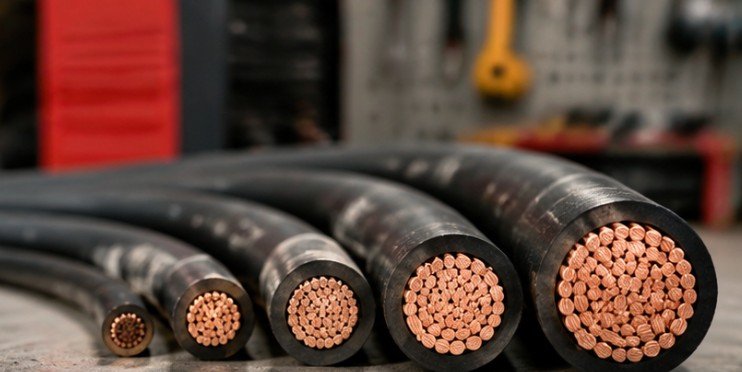
The actual cable length calculation is:
Electrode cable length + work cable length = total circuit length
For example:
A welder positioned 75 feet away from a structure may require:
- 75 feet of electrode cable
- 75 feet of work cable
The total electrical path becomes 150 feet.
That additional distance significantly affects resistance.
A longer cable run also creates more opportunity for:
- Heat buildup
- Reduced arc stability
- Lower penetration
- Poor starts
- Increased strain on connectors
Recommended Welding Cable Sizes for Long Runs
There is no single cable size that works for every welder. A 200-amp stick welder running occasionally does not have the same requirements as a 400-amp industrial machine operating continuously.
The table below provides practical starting points for common welding setups.
| Welding Output | Approximate Total Lead Length | Common Cable Size Recommendation |
| Up to 200 amps | 100–150 feet | 1/0 AWG to 2/0 AWG |
| 200–300 amps | 100–200 feet | 2/0 AWG to 3/0 AWG |
| 300–400+ amps | Long industrial runs | 3/0 AWG to 4/0 AWG |
These are general guidelines. The machine manufacturer’s recommendations should always take priority because duty cycle and operating conditions change the required cable capacity.
For example, a 250-amp welder used intermittently may operate comfortably with a smaller cable than the same machine running near maximum output for extended periods.
How to Calculate the Right Cable Size for Your Setup
Before purchasing welding leads, check these four factors.
1. Determine Maximum Welding Amperage
Look at the machine’s rated output, not just the model name.
A 300-amp machine does not always operate at 300 amps. However, the cable should be capable of handling the maximum current you realistically expect to use.
2. Measure the Complete Cable Path
Add both cables together.
Example:
150 feet electrode lead + 150 feet ground lead = 300 feet total circuit length.
A setup this long may require significantly larger cable than a normal shop arrangement.
3. Consider Duty Cycle
Duty cycle describes how long a welder can operate within a specific period before cooling is required.
A machine used for short repair welds may tolerate conditions that would overheat cables during continuous production welding.
4. Check Your Welding Process
Different welding processes place different demands on cables.
- Stick welding often uses long leads because the power source may be far from the work area.
- TIG welding usually requires careful voltage control because arc stability is critical.
- MIG welding typically keeps the gun cable shorter, but long feeder setups may require special considerations.
Common Mistakes When Using Long Welding Leads
Many cable problems are caused by installation choices rather than the cable itself.
Using Small Cable Because It Fits the Connectors
A smaller cable may be cheaper and easier to handle, but it creates more resistance. The cable may become hot while the welder struggles to maintain a stable arc.
Ignoring Connection Quality
A large cable cannot compensate for poor connections.
Inspect:
- Dinse connectors
- Lugs
- Work clamps
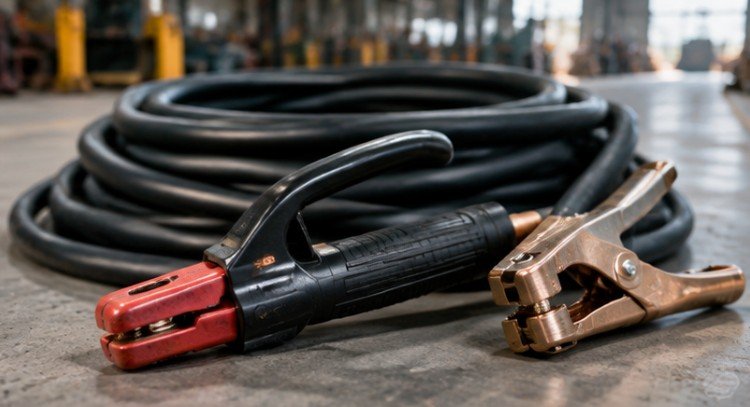
- Electrode holders
Loose or corroded connections create resistance points that generate heat.
Adding Too Many Cable Extensions
Breaking a long run into shorter sections with quick connectors can improve portability. However, every connection adds another potential resistance point.
For occasional field work, modular leads can be practical. For heavy continuous welding, a single properly sized cable is often the better option.
How to Reduce Voltage Drop on Long Welding Leads
If your cable run is already installed and performance is poor, several improvements can help.
First, increase cable size. Moving from 1/0 AWG to 2/0 AWG can noticeably reduce resistance over long distances.
Second, shorten the leads whenever possible. Even removing 25 feet of unnecessary cable can improve performance.
Third, place the work clamp as close as practical to the weld area. A long ground path increases resistance and can reduce arc efficiency.
You should also inspect cable condition regularly. Cuts, crushed sections, overheated insulation, and damaged connectors can compromise safety.
The National Institute for Occupational Safety and Health (NIOSH) provides workplace safety research showing why controlling electrical hazards and maintaining equipment condition are essential in industrial environments.
A Simple Long-Lead Welding Cable Checklist
Before using a long welding cable setup, verify:
- Machine maximum amperage is known
- Total cable length is calculated correctly
- Cable gauge matches the current and distance
- Connectors are tight and clean
- Cable insulation has no damage
- Leads are not coiled tightly during heavy welding
- Cables are protected from sharp edges and vehicle traffic
For larger fabrication projects, proper cable selection should be treated as part of the welding setup—not an accessory purchased afterward.
You can also improve your overall welding preparation by understanding related equipment choices, such as selecting the correct for your specific application.
Does Bigger Welding Cable Always Mean Better?
A larger cable reduces resistance, but oversized cable is not always practical.

Very large cables become:
- Heavier to carry
- More expensive
- More difficult to position
For a mobile repair welder, flexibility and portability matter. For a fixed fabrication shop, heavier cable may make more sense because performance and durability are priorities.
The goal is not the largest cable—it is the correct cable.
Frequently Asked Questions
1. What size welding cable do I need for a 200 amp welder with long leads?
For long runs around 100–150 feet total, 1/0 AWG or 2/0 AWG cable is commonly used, depending on duty cycle and operating conditions.
2. Can small welding cables damage a welder?
Undersized cables usually cause voltage drop and heat buildup. They reduce performance and may shorten cable life, although they do not typically damage the welder directly.
3. Does welding cable length include both leads?
Yes. Add the electrode cable and work cable together to calculate the total electrical path length.
4. Is 4/0 welding cable necessary for most jobs?
No. 4/0 cable is typically reserved for very high amperage applications, extremely long runs, or industrial welding environments.
Final Thoughts
The surprising part about long welding leads is that the cable often becomes the limiting factor, not the welder. A powerful machine can still produce a weak arc if electrical resistance steals performance before the current reaches the joint.
Choosing the correct welding cable size for long leads comes down to understanding amperage, total circuit length, duty cycle, and job conditions. For most serious welding setups, investing in properly sized cable is cheaper than dealing with inconsistent welds, overheated leads, and unnecessary downtime. Measure the distance, match the gauge, and let the machine perform the way it was designed to.