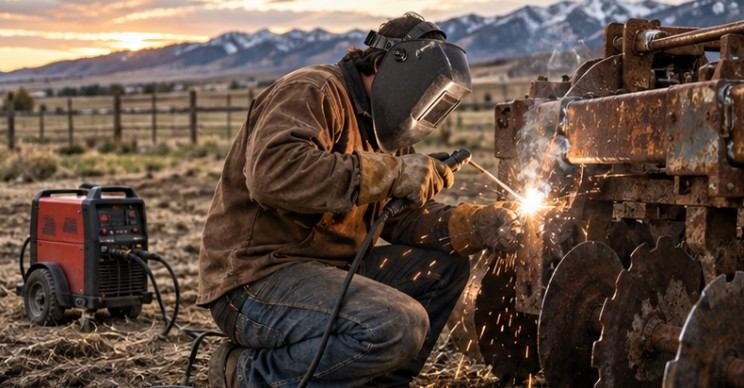
A breeze that barely moves the leaves can already matter to a weld. The Federal Highway Administration’s Bridge Welding Reference Manual notes that gas-shielded FCAW used under the Bridge Welding Code is limited to wind around the arc of 5 mph unless shielding is provided. That gives you an idea of how easily moving air can disrupt gas protection.
For most field repairs, the best welding process for outdoor welding is shielded metal arc welding (SMAW), better known as stick welding. When higher productivity is important, self-shielded flux-cored arc welding (FCAW-S) is often the stronger choice. Neither requires a separate shielding-gas cylinder, making both far more tolerant of real jobsite conditions than conventional MIG or TIG.
Why Outdoor Welding Changes the Process Choice
Every arc weld has to protect molten metal from the surrounding atmosphere. Oxygen, nitrogen, moisture, dirt, and other contaminants can contribute to porosity, cracking, oxidation, or other weld defects.
The problem outdoors is that conditions constantly change. A calm morning can turn windy. Steel left overnight can collect condensation. Dust can blow across a prepared joint, and sparks can travel into dry grass or nearby combustible material.
Gas-shielded processes are particularly vulnerable because their protective envelope comes from gas flowing through the torch. Wind can pull that shield away from the puddle before the weld solidifies.
That is why outdoor suitability is not simply about whether a machine will strike an arc. It is about whether the process can maintain weld quality under uncontrolled conditions.
Stick Welding Is the Most Versatile Field Option
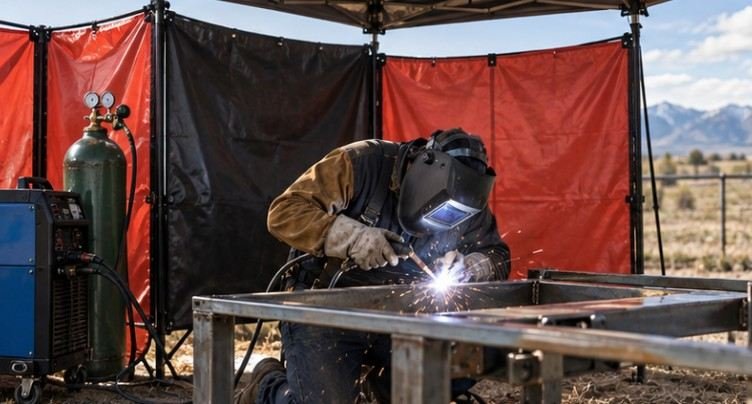
Stick welding technique creates an arc between the workpiece and a flux-coated consumable electrode. As the coating decomposes, it helps protect the molten weld metal and produces slag over the cooling bead.
The American Welding Society describes SMAW as unusually versatile and notes that a basic setup requires little more than a power source, electrode holder, work connection, cables, and electrodes. That simplicity is a major advantage when repairs have to happen hundreds of feet from a fabrication shop. Stick is particularly practical for farm machinery, structural repairs, heavy equipment, gates, trailers, pipe work, and other carbon-steel jobs where perfect surface preparation may be difficult.
It also handles scale, moderate rust, and less-than-perfect surfaces more gracefully than many wire processes. That does not mean preparation should be skipped. Grinding away oil, loose rust, paint, moisture, and heavy mill scale still improves consistency and reduces contamination.
The main trade-off is productivity. Electrodes eventually burn down and must be replaced, slag has to be removed, and maintaining arc length requires more operator skill than feeding continuous wire.
Self-Shielded Flux Core Wins When Speed Matters
For production-oriented field work, FCAW-S deserves equal attention.
Instead of individual electrodes, the process feeds tubular wire continuously through a gun. Fluxing compounds inside the wire provide protection without requiring an external shielding-gas bottle.
AWS specifically distinguishes self-shielded FCAW from gas-shielded FCAW. FCAW-S is designed for applications where external gas is unnecessary, while FCAW-G still depends on shielding gas and therefore remains vulnerable to wind.
The continuous wire makes FCAW-S attractive for structural erection, construction, heavy repair, and longer welds where stopping repeatedly to change electrodes would reduce productivity.
FHWA’s bridge welding guidance also describes FCAW-S as well suited to field conditions where wind could interfere with gas shielding. The manual cites testing simulating 10-mph wind without harmful effects, although that figure should never be treated as a universal operating limit. The approved welding procedure, electrode manufacturer, project specification, and governing code still control the job.
Outdoor Welding Processes Compared
| Process | Wind Tolerance | Productivity | Best Outdoor Use | Main Limitation |
| Stick/SMAW | Excellent | Moderate | Repairs, farms, equipment, structural steel | Slag and electrode changes |
| FCAW-S | Excellent | High | Construction and longer structural welds | More spatter, slag, wire-specific requirements |
| MIG/GMAW | Poor without shelter | High | Sheltered outdoor fabrication | Wind disrupts shielding gas |
| TIG/GTAW | Poor without shelter | Low | Precision work in tightly controlled areas | Extremely sensitive shielding |
| FCAW-G | Poor to moderate with shelter | High | Protected structural work | Still requires external gas |
For general steel field repair, that comparison is why stick usually earns the title of best welding process for outdoor welding, while FCAW-S becomes especially attractive when deposition rate and continuous production matter.
Why MIG and TIG Are Not Automatically Bad Outdoors
Saying MIG or TIG “cannot” be used outside goes too far. The real problem is shielding. Know what materials can mobile welders weld.
A properly designed welding screen, temporary enclosure, tent, or windbreak can create a sufficiently controlled work area. Once wind is controlled, MIG can offer fast travel speeds and clean wire feeding, while TIG can provide excellent control for thin stainless steel, aluminum, or precision fabrication.
However, simply turning up the shielding-gas flow is not a reliable fix. Excessive flow can create turbulence and pull surrounding air into the shielding zone.
This distinction becomes especially important for code-controlled structural work. The applicable welding procedure specification and project code—not guesswork about how windy the day feels—should determine whether welding continues.
A Five-Step Field Test Before Striking the Arc
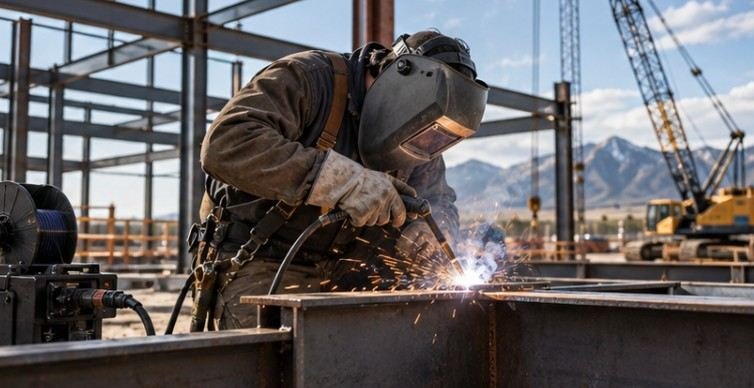
1. Identify the metal and required weld
Stick and FCAW-S are particularly useful for carbon and low-alloy steels. Thin stainless or aluminum may push the decision toward a gas-shielded process and therefore require a protected work area.
2. Check the wind at the actual joint
Conditions behind a beam, beside a building, or inside a partially erected structure can differ dramatically from conditions a few feet away. Evaluate air movement where the arc will actually be operating.
3. Inspect moisture and electrical exposure
Do not treat rain, puddles, wet gloves, damaged leads, or wet equipment as minor inconveniences. OSHA requires Arc Welding and Cutting requirements to be maintained and operated with electrical hazards in mind, including safe handling of electrode holders and equipment.
4. Remove contamination and combustibles
Clean the joint even when using a forgiving process. Then look beyond the steel. Sparks and hot slag can travel much farther than the puddle itself.
Harvard Environmental Health and Safety treats welding as hot work because it can generate heat, flame, and ignition sources, reinforcing why fire prevention must be part of outdoor setup rather than an afterthought.
5. Confirm the WPS, consumable, and polarity
“Flux core” alone is not enough information. Some wires are self-shielded; others require gas. Electrode classification, polarity, wire diameter, amperage, voltage, stickout, and permitted positions must match the procedure and manufacturer instructions.
Outdoor Air Does Not Eliminate Fume Risk
One surprisingly persistent misconception is that welding outside automatically solves ventilation problems.
NIOSH specifically warns against assuming that open-air welding provides adequate ventilation. Wind direction can actually carry fumes directly through a welder’s breathing zone, and coatings or metals containing hazardous constituents can increase exposure concerns.
Positioning yourself out of the fume plume, removing hazardous coatings safely, using appropriate controls, and following respiratory-protection requirements remain important even on an open jobsite.
Where the Usual Recommendation Does Not Apply
There is no single process that wins every outdoor job.
A short repair on rusty carbon steel may strongly favor SMAW. Hundreds of feet of structural weld may make FCAW-S far more productive. An aluminum assembly may require MIG or TIG inside a wind-controlled enclosure. Critical structural, pressure, pipeline, or transportation work may also have procedure and inspection requirements that override convenience.
That is why experienced welders choose the process after considering metal, joint design, environment, specification, productivity, access, and required weld properties—not simply whether the work happens outside.
FAQs
1. Is stick or flux core better for outdoor welding?
Stick is usually simpler and more portable for repair work. Self-shielded flux core is generally faster for longer welds because wire feeds continuously.
2. Can you MIG weld outside?
Yes, but the weld area must be protected from drafts that disturb shielding gas. Windbreaks or temporary enclosures are commonly needed for consistent results.
3. Can TIG welding be done outdoors?
It can, but TIG’s argon shielding is highly sensitive to moving air. Outdoor TIG generally requires a well-protected work area with controlled wind.
4. Should you weld outside in the rain?
Welding in wet conditions creates serious electrical and quality concerns. Stop work when equipment, the welding area, or working conditions cannot be kept suitably dry and safe.
Choosing the Process That Keeps Working When Conditions Change
The best welding process for outdoor welding is ultimately the one that can protect the weld pool reliably while meeting the job’s mechanical and procedural requirements. For everyday field repair, that usually points to stick welding. For faster structural or production work, self-shielded flux core often has the advantage.
MIG and TIG still have a place outside, but the environment must be brought under control first. The key lesson is simple: do not choose a process because it works perfectly inside the shop. Choose the one that continues producing sound welds after the shop walls disappear.