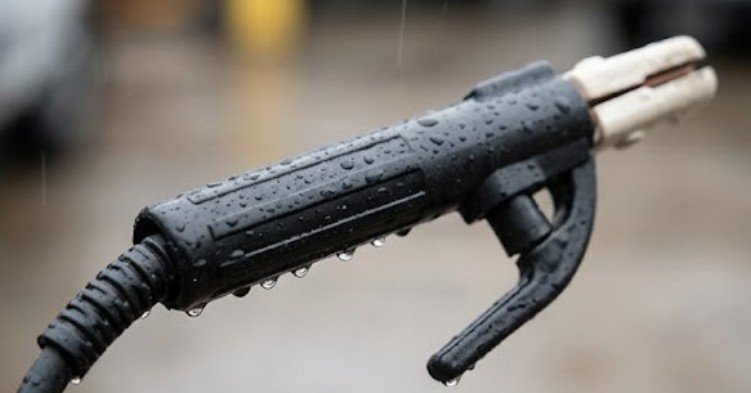
A damp leather glove can drop the electrical resistance of human skin from roughly 100,000 ohms to less than 1,000 ohms in seconds. When you hold an active electrode holder under those conditions, standard open-circuit voltages become lethal fast. Understanding welding in the rain safety isn’t just about wearing rubber boots—it requires knowing how water alters electrical pathways and structural metallurgy.
Why Water Turn Arc Welding Into a Life-Threatening Hazard
Arc welding relies on an electrical circuit completing through your workpiece. When rain or heavy humidity enters the equation, water acts as an opportunistic conductor, creating unintended current paths across your body.
According to guidelines published by the Occupational Safety and Health Administration (OSHA), electrocution remains one of the primary hazards on construction and industrial sites. Open-circuit voltage (OCV)—the potential present at the electrode holder before an arc strikes—typically ranges between 50V and 80V DC or AC. While dry skin naturally resists this level of current, soaked skin drastically lowers body impedance.
When your resistance drops, even low voltages force dangerous levels of amperage across your heart. This triggers ventricular fibrillation or muscle lockup, preventing you from letting go of the torch.
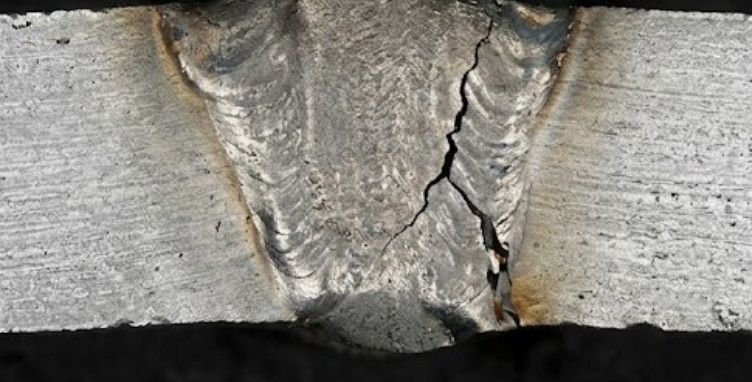
Beyond electrical shock, rain creates severe structural vulnerabilities in metal. The extreme heat of the welding arc breaks down airborne water molecules into hydrogen and oxygen. When free hydrogen dissolves into a molten weld pool, it becomes trapped as the metal solidifies, leading to hydrogen-assisted cracking—often called cold cracking—hours or days after the job is finished.
Technical Comparison of Rain Risks Across Major Welding Processes
Different welding processes carry unique risk profiles when exposed to moisture. The table below outlines how common techniques react to rain across safety, quality, and equipment survival factors.
| Welding Process | Shock Risk Level | Shielding Failure Risk | Structural Weld Degradation | Equipment Damage Hazard |
| Shielded Metal Arc (Stick) | High (Constant OCV at holder) | Moderate (Flux coating absorbs water) | High (Hydrogen embrittlement, severe porosity) | Moderate (Rugged transformer designs handle damp air better) |
| Gas Metal Arc (MIG/GMAW) | Moderate to High | Critical (Wind/rain displaces shielding gas) | High (Porosity, wormholes, lack of fusion) | Severe (Complex wire feeders and PC boards short easily) |
| Gas Tungsten Arc (TIG/GTAW) | High (High-frequency start surges) | Critical (Shielding gas envelope collapses) | Extreme (Immediate tungsten contamination and cracking) | Severe (Sensitive inverter electronics fail when wet) |
| Flux-Cored Arc (FCAW-S) | High (Self-shielded wires) | Low (No external gas stream needed) | Moderate to High (Moisture inside wire core causes porosity) | Moderate to High |
The Four Core Dangers of Wet Weather Fabrication
1. Electrical Shock and Electrocution
Standing in puddles or wearing damp leather gear creates a direct path to ground. Alternating Current (AC) machines present a higher biological shock hazard than Direct Current (DC) machines because AC current triggers severe muscle contractions at lower thresholds.
2. Hydrogen-Assisted Cracking and Porosity
Water vapor introduced into the arc plasma breaks down into monatomic hydrogen. According to research published by the American Welding Society (AWS), atomic hydrogen diffuses rapidly through crystalline steel matrices, accumulating at micro-defects and causing catastrophic joint failure under stress.
3. Destruction of Electronic Equipment
Modern inverter-based welding power sources rely on delicate circuit boards to regulate pulse parameters. Water intrusion causes short circuits, blows power transistors, and voids manufacturer warranties instantly.
4. Lightning and Atmospheric Strikes
Outdoor field operations during active rain storms increase exposure to cloud-to-ground lightning strikes, especially when working on elevated steel frameworks or pipeline corridors.
Essential On-Site Checklist Before Striking an Arc Outdoors
Before starting any outdoor job in damp conditions, complete this quick verification sequence:
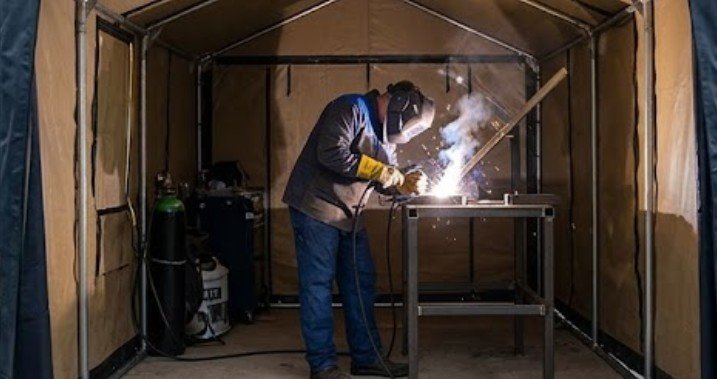
- Enclosure Verification: Is a waterproof canopy, tent, or shelter fully deployed over the work zone and welding machine?
- Grounding Check: Is your standing surface elevated off wet soil using dry wood pallets or thick rubber dielectric mats?
- PPE Audit: Are your leather welding gloves, boots, and fire-resistant jackets 100% dry inside and out?
- Cable Integrity: Are all primary power cables, electrode leads, and ground clamps completely free of cuts, cracks, or exposed copper?
- Code Compliance: Have you verified that applicable structural codes permit work under current weather conditions?
Field Mitigation: How to Weld Safely When Rain Threatens
If an emergency repair forces you to work outdoors during light precipitation, strict environmental controls are legally and operationally required.
Build Complete Overhead Isolation
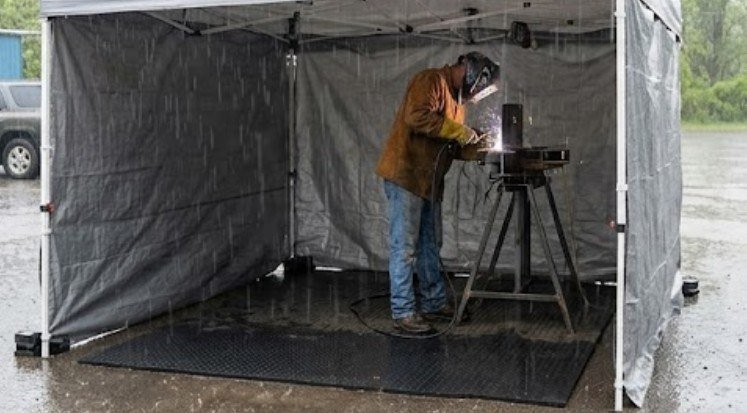
Setting up a flame-retardant shelter or temporary weld tent is mandatory. The shelter must prevent driving rain from hitting your workpiece, your welding torch, and your power source.
Isolate Your Body from the Ground
Never touch bare metal structures or wet ground directly with your body. Stand on dry wooden scaffolding planks or thick rubber insulation mats tested for electrical resistance.
Wear Dry, Insulated Protective Equipment
Keep spare pairs of dry leather gloves in airtight bags on-site. The moment your gloves absorb sweat or rain, change them immediately. Consider wearing a Voltage Reduction Device (VRD) on your power source to drop open-circuit voltage when the machine is idling.
Adhere to Industry Codes
Standard fabrication codes—such as those maintained by the National Fire Protection Association (NFPA) regarding hot work safety—strictly prohibit welding in direct precipitation unless structural enclosures completely eliminate moisture hazards.
Industry Standards and Code Restrictions
Regulatory and engineering standards leave little room for interpretation regarding wet weather welding. The structural welding code AWS D1.1 explicitly states that welding shall not be done when the ambient surface is wet or exposed to rain, snow, or high winds, unless proper windbreaks and shelters are erected.
Similarly, military and marine specifications enforced by the U.S. Navy Naval Sea Systems Command (NAVSEA) mandate immediate shutdown of outdoor hull fabrication if moisture condensation or rainwater touches the joint preparation area. Preheating the base metal to evaporate surface moisture is standard protocol, but it does not replace the requirement for total shelter from active precipitation.
FAQ
1. Can you get shocked while welding in light rain?
Yes. Light rain dampens clothing and skin, significantly lowering your electrical resistance. This allows open-circuit voltage from the electrode holder to pass through your body to the ground.
2. What happens if water gets inside a MIG welder?
Water shorts out internal circuit boards, wire drive motors, and transformers. This leads to immediate machine failure, potential electrical fires, and expensive component replacements.
3. Does preheating metal fix wet welding problems?
Preheating drives off surface condensation, but it cannot counteract active rain. Rain falling onto a hot joint creates steam, introducing hydrogen into the arc and causing rapid cooling cracks.
4. Is DC welding safer than AC welding in damp conditions?
DC current is generally less likely to cause involuntary muscle lockup at standard open-circuit voltages than AC current, but both can be lethal under wet conditions.
Maintaining jobsite safety requires uncompromised standards, correct equipment, and rigorous field procedures. Wet conditions dramatically elevate electrical conductivity while compromising weld metal integrity at a molecular level. By erecting complete weather shelters, using rubber isolation barriers, maintaining dry PPE, and following strict code guidelines, fabrication teams can eliminate electrocution hazards and prevent catastrophic weld failures on every project.