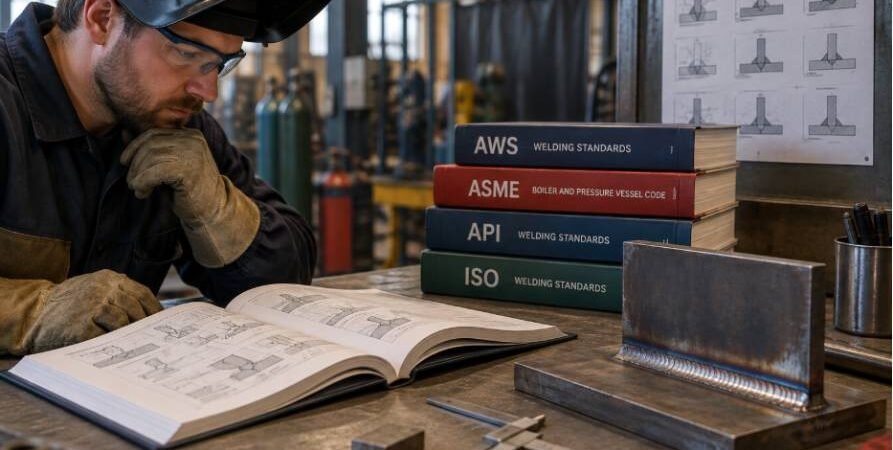
I first noticed how often welding conversations change when someone asks which code applies to a job. A weld can look clean and still fail a project requirement if the procedure, material, qualification, or inspection criteria do not match the governing specification. That made me realize that understanding welding codes and standards is not just paperwork. It helps define what a successful weld actually means.
I also found that code books seem intimidating because they are written for precision. Once the purpose of each document becomes clear, the system feels more manageable. Instead of memorizing requirements, it helps to understand who created the rule, what work it covers, and how it affects the people doing the work.
What Welding Codes and Standards Actually Do
Welding codes establish technical requirements for how certain welded work is designed, qualified, fabricated, inspected, and accepted. Standards can provide recognized methods, terminology, testing practices, or specifications. A project specification may then identify which code and edition must be followed.
There is no single rulebook covering every weld. Structural steel, pressure equipment, pipelines, bridges, and specialized fabrication can have different requirements. The applicable document depends on the project, not simply the welding process.
Which Organizations Write the Rules?
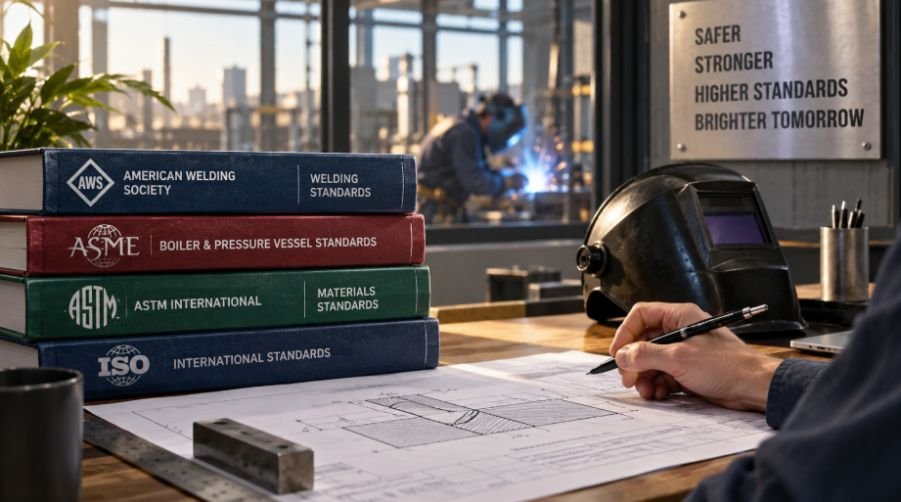
The American Welding Society is central to structural welding. AWS D1.1 addresses welded structures made from commonly used carbon and low-alloy structural steels, including fabrication, qualification, inspection, and acceptance.
ASME Section IX focuses on qualifying welding, brazing, and fusing procedures and personnel. Pipeline work can involve API Standard 1104, which covers welding pipelines and related facilities. The job determines which requirements apply.
The Documents Behind a Qualified Weld
Three documents make the qualification process easier to understand.
A Welding Procedure Specification, or WPS, tells qualified personnel how the weld is to be made within approved ranges. It can address the process, joint details, base material, filler metal, position, electrical variables, preheat, and interpass temperature.
A Procedure Qualification Record, or PQR, provides evidence from a qualification test. It records what was used during the test and the results of required examinations or mechanical tests. The PQR supports the procedure.
Welder Performance Qualification, often called WPQ, addresses the person performing the work. It demonstrates that the welder or welding operator can produce acceptable welds under specified conditions and within the ranges allowed by the governing code.
Why Welding Variables Matter
This is where code knowledge becomes practical. A small change in a welding procedure is not automatically equal to another small change. Codes classify variables according to their potential effect on weld performance.
Essential variables can trigger requalification when changed beyond permitted limits. These may involve the welding process, material group, filler classification, thickness range, or other significant conditions.
Supplementary essential variables matter when toughness or impact requirements apply. A change acceptable for one job can require additional qualification on another.
Nonessential variables generally do not require a new qualification test, although the WPS still needs to remain accurate and controlled.
Reading a Code Without Getting Lost
Start with scope. Determine what the document covers and whether the project specification invokes it. Then identify sections dealing with materials, qualification, fabrication, inspection, and acceptance.
Keep the project documents together. The drawing, specification, WPS, qualification records, inspection requirements, and applicable code should tell the same story. If they conflict, resolve the issue before production welding continues.
Why Current Editions Matter
Codes change because materials, equipment, testing methods, fabrication practices, and industry experience change. AWS continues to revise its structural welding publications.
That means pulling an old code book from a shelf is not enough. A project may specify a particular edition, amendment, or contract requirement. Using the wrong edition can create confusion over qualification ranges, inspection criteria, terminology, or acceptance requirements.
Good code practice includes document control. Check the edition, amendments, errata, and project-specific references before relying on a requirement.
The Skills Behind Code Compliance
Code knowledge is part of a professional skill set. Welders still need process control and hands-on judgment, but fabrication also rewards people who can read technical documents, understand qualification records, and recognize when a proposed change needs review.
That makes future skills for the welding workforce broader than learning another process. Technical literacy can help a welder move toward inspection, supervision, quality control, or coordination.
Technology adds another layer. Automated welding, digital records, and advanced inspection tools are changing how work is planned and verified. Understanding how welding technology is changing careers can help workers stay useful as tools change.
A Practical Habit Worth Building
The best way to become comfortable with codes is to treat them as working references, not books to memorize. Start with project requirements, identify the governing code, confirm the edition, and check the WPS against relevant qualification and inspection provisions.
When something changes, pause before assuming it is acceptable. A different material, process, filler, position, thickness, heat input, or service requirement may affect qualification. Asking first can prevent expensive rework.
Frequently Asked Questions
1. What is the difference between a welding code and a standard?
A code establishes requirements for design, fabrication, qualification, inspection, or acceptance within a defined application. A standard can provide recognized practices, methods, terminology, or specifications.
2. Is AWS D1.1 used for every welding job?
No. AWS D1.1 is intended for structural steel applications covered by its scope. Other industries and materials may fall under different AWS, ASME, API, or project-specific requirements.
3. What does a WPS tell a welder?
A WPS provides ranges for making a weld. It can cover the process, materials, joint details, filler metal, position, and important welding variables.
4. Why do welding codes get updated?
Codes are revised as materials, technology, testing methods, fabrication practices, and industry experience develop. Projects should follow the edition and amendments specified by their requirements.
Why Code Knowledge Becomes a Professional Advantage
A welder who understands codes can see beyond the weld bead. The work connects material selection, qualification, inspection, documentation, safety, and the finished component. That broader view can reduce mistakes because decisions are based on requirements rather than appearance alone. It also improves communication when teams solve problems together.
Strong code knowledge is practical. Know what governs the job, where to find the requirement, and when a change deserves a second look. That habit can protect quality, save time, and strengthen a welding career.