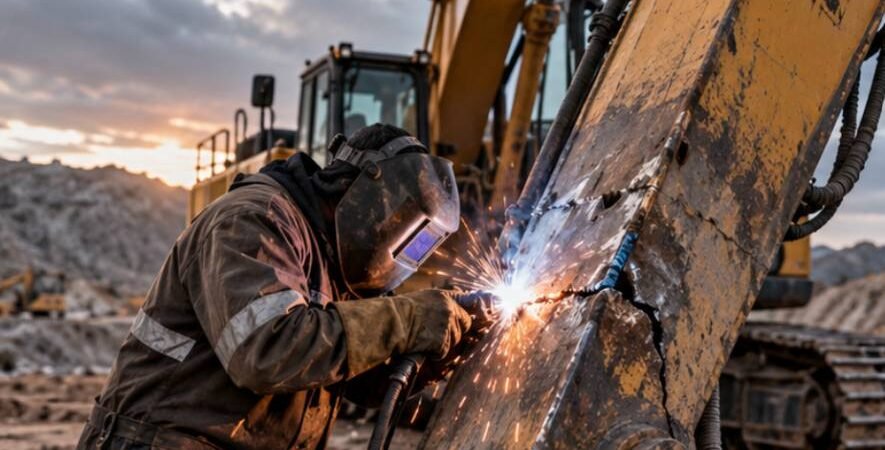
A cracked excavator boom can look like a simple welding job, but the visible crack is often only the last symptom of a larger problem. Worn pin bores, repeated shock loading, poor fit-up, or an earlier repair may keep concentrating stress in the same place. That is why heavy equipment welding repair should begin with diagnosis, not an arc strike.
For U.S. contractors, farms, quarries, fleet operators, and equipment owners, the goal is to restore safe function without creating a brittle, misaligned, or electronically damaged machine.
Why Heavy Equipment Welding Repair Is Different
Buckets, booms, loader arms, frames, rippers, blades, and attachment mounts work under repeated impact and cyclic loading. A weld can look clean and still fail early if the base metal, joint preparation, hydrogen control, heat input, or crack-removal method is wrong.
The American Welding Society’s D14.0/D14.0M:2024 machinery specification covers repair, inspection, welding procedures, and quality requirements for machinery and equipment. That matters because heavy-equipment steel should not automatically be treated as ordinary mild steel.
A California Polytechnic State University field-repair study likewise notes that high-strength steels can require special metallurgical consideration, while limited jobsite tooling can make field repairs harder to control.
Find the Cause Before Fixing the Crack
A recurring failure usually means the crack was not the only defect.
Imagine an excavator bucket ear cracked beside a pin bore. If the bore has worn oval and the pin is moving under load, welding the crack alone leaves the abnormal movement in place. The repaired area may fail again.
Inspection should consider the load path, distortion, worn pins or bushings, old repairs, and whether the crack extends beyond what is visible. Nondestructive examination may be appropriate after preparation.
The crack itself must also be removed to sound metal. On thick sections, technicians may use grinding, thermal cutting, or air-carbon arc gouging before rebuilding the joint. Simply welding over a crack can leave the original discontinuity beneath the new bead.
When Bore Welding and Line Boring Are Needed
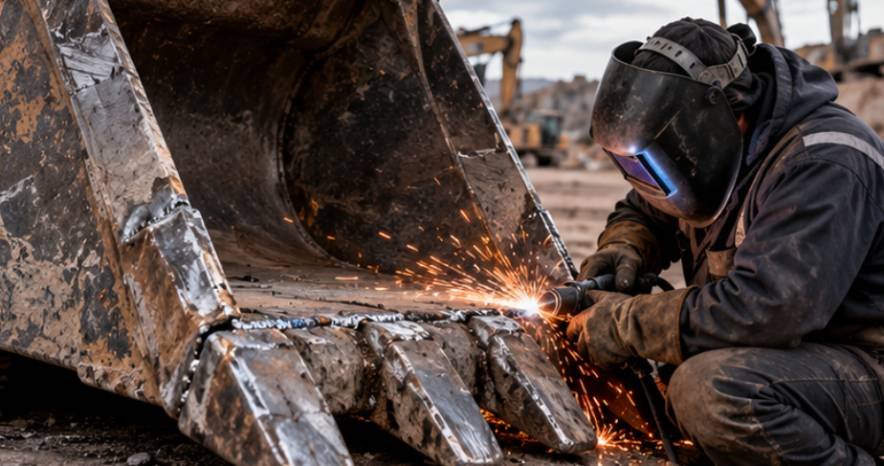
Loose pivots are not the same problem as surface cracking. Once a pin hole becomes oversized, out-of-round, or misaligned, a new bushing alone may not restore the geometry.
Bore welding adds material inside the worn hole. Line boring then machines the rebuilt bore back to the required diameter and centerline. This matters on booms, linkages, bucket pivots, and cylinder mounts where multiple bores must stay aligned.
A mobile welder may be excellent at structural repair but may not carry line-boring equipment. If the machine has sloppy pins or egg-shaped bores, ask specifically about portable bore welding, line boring, measurement capability, and final bushing fit.
Field Repair or Shop Repair?
Mobile repair can reduce hauling and downtime. Shop repair offers better control over position, cleanliness, preheat, machining, and inspection.
Understanding what a mobile welder does helps equipment owners decide whether a repair can realistically be completed on-site or whether the component should go to a shop.
| Situation | Field repair may work well | Shop repair may be better |
| Localized accessible crack | Yes | If distortion or deeper damage exists |
| Worn pin bore | Yes, with portable line boring | Yes, for major machining |
| Detached bucket or blade | Possible | Often practical |
| Major boom/frame deformation | Limited | Better for fixturing and measurement |
| Repeat structural failure | Temporary or diagnostic work | Better for detailed inspection |
If a field setup cannot hold alignment, control heat, remove contamination, or inspect the finished weld, transporting the component may be cheaper than repairing it twice.
Five Checks Before the Arc Starts
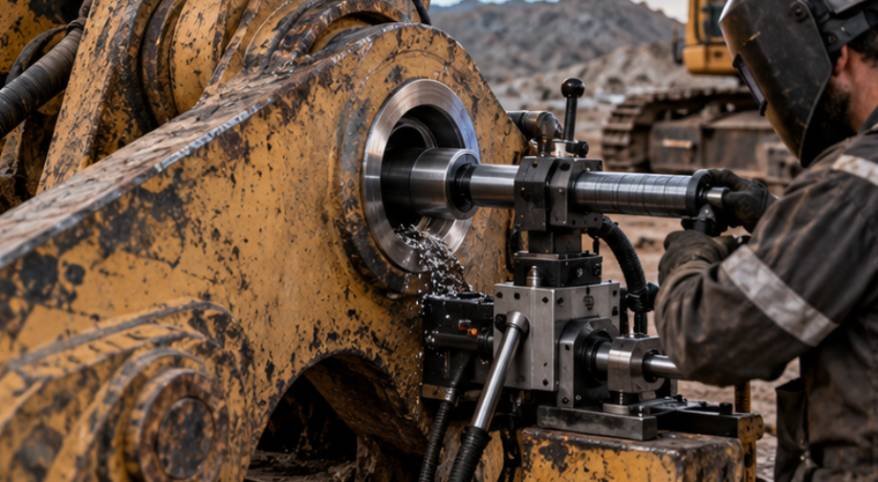
- Identify the base material or obtain the manufacturer’s repair procedure. Do not choose filler metal or preheat by appearance alone.
- Remove paint, grease, oil, moisture, and the full crack to sound metal.
- Check alignment, pins, bushings, and nearby structure so the repair addresses the original load problem.
- Control stored energy and prevent machine movement. OSHA’s lockout/tagout principles address hazardous energy during applicable servicing work; requirements differ by industry and work setting.
- Follow the equipment manufacturer’s welding procedure for electrical protection. Many OEM procedures specify electrical isolation and placing the welding return clamp close to the repair, but the exact sequence varies by machine.
Heat Control Can Decide Whether the Repair Lasts
Preheat is not simply a case of “more heat is better.” It can slow cooling and reduce susceptibility to hydrogen-assisted cracking in certain steels. The required temperature depends on material chemistry, thickness, restraint, filler metal, ambient conditions, and the repair procedure.
Purdue repair-welding research has examined how preheating affects stress distribution during multi-pass repairs, showing why temperature control is an engineering variable rather than guesswork.
Low-hydrogen electrodes such as E7018 are common in structural welding, but they are not automatically correct for every component. Strength, toughness, storage condition, and manufacturer requirements still matter.
Jobsite Safety Is Part of Weld Quality
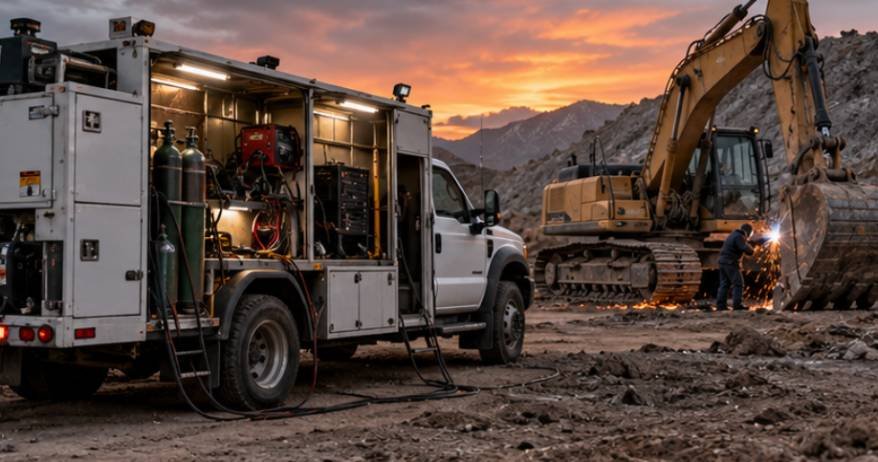
Heavy-equipment repair combines hot work with fuel, grease, hydraulic oil, batteries, coatings, compressed-gas cylinders, and stored mechanical energy.
OSHA’s welding and cutting requirements call for fire-prevention measures and, under specified conditions, fire watches and readily available extinguishing equipment. OSHA also states that appreciable combustibles within 35 feet of certain hot-work operations can trigger additional fire-watch precautions.
Fume control matters too. NIOSH welding-fume guidance reports that welding fumes contain metals and that manganese is present in most welding fumes.
It also notes that confined-space welding can significantly increase manganese-fume exposure. Ventilation, coating removal, and respiratory protection where required should therefore be planned before work begins.
Outdoor aluminum welding also requires careful control of wind and shielding gas, as changing field conditions can affect weld quality and safety.
How to Judge a Repair Provider
Ask for more than “we can weld it.” A capable provider should be able to explain what caused the damage, how the crack will be removed, what material is being repaired, which procedure and consumable apply, whether preheat is required, and how the finished repair will be inspected.
For worn pivots, ask whether the provider can measure bore alignment and perform both buildup and machining. For critical booms, frames, or repeat failures, ask whether manufacturer guidance, an engineer, qualified procedures, or nondestructive examination is needed.
The cheapest quote is not the lowest-cost repair if poor preparation brings the machine down again.
Frequently Asked Questions
1. Can a cracked excavator boom be welded?
Often, yes, but the repair depends on crack location, steel grade, distortion, loading, and manufacturer guidance. Critical or repeatedly cracked structures may require engineered procedures and nondestructive inspection.
2. What is line boring in heavy equipment repair?
Line boring machines worn or rebuilt pin bores back to the correct diameter and alignment. It is commonly paired with bore welding when pivot holes become oversized or oval.
3. Should every heavy-equipment crack be air-arc gouged?
No. The defect must be removed to sound metal, but the removal method depends on material, thickness, access, available equipment, and the approved repair procedure.
4. Should batteries be disconnected before welding?
Follow the machine manufacturer’s instructions. Many OEM procedures require electrical isolation and a welding return clamp close to the repair, but exact steps vary by machine.
A Repair Should Restore the Load Path, Not Hide Damage
The most important part of heavy equipment welding repair happens before the bead is deposited. The technician must understand why the metal failed, remove the defect, control geometry and heat, protect people and electronics, and verify the finished component.
A shiny bead may make a crack disappear. A lasting repair restores sound metal, alignment, and the intended load path. When equipment downtime is expensive, that difference is worth discussing before a service truck ever strikes an arc. The best repair is not the fastest-looking fix; it is the one that solves the failure mechanism and keeps the machine working safely.