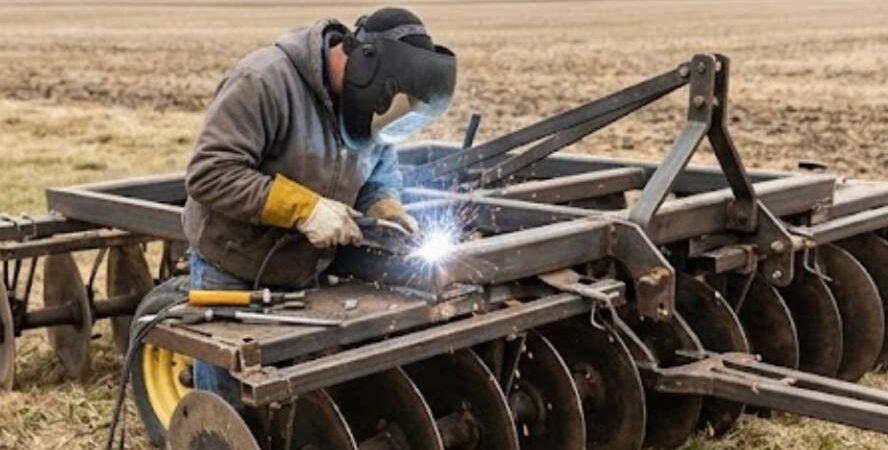
Nearly 75% of catastrophic agricultural machinery failures stem not from primary component manufacturing defects, but from fatigue cracks that were improperly repaired during seasonal downtime. When a high-stress implement like a tillage shank or loader arm snaps in the middle of harvest, a hasty, structural weld job can mean the difference between a thirty-minute pause and tens of thousands of dollars in ruined equipment and lost yield.
Field repair of agricultural machinery is a specialized discipline where metallurgy, environmental conditions, and structural mechanics collide. Executing a lasting farm equipment welding repair requires moving beyond basic joint-joining tactics and understanding how heavy dynamic loads affect heat-affected zones in modern high-strength steels.
The Hidden Mechanics of Agricultural Metal Fatigue
Farm implements endure cyclic loading patterns unlike almost any other industrial equipment. Tillage tools, combine headers, and baler frames endure constant flex, vibration, and soil resistance. Over time, these dynamic forces concentrate at welded joints, structural gussets, and bolted pivot points.
Modern agricultural equipment increasingly relies on high-strength, low-alloy (HSLA) steels to reduce overall implement weight while maintaining structural strength. However, welding HSLA steel requires strict thermal control. Applying excessive heat during a field patch can degrade the metal’s heat treatment, softening the region adjacent to the weld—known as the Heat-Affected Zone (HAZ)—and inviting immediate re-cracking under normal working stress.
Understanding metal composition is critical. The American Welding Society provides comprehensive codes and material standards that clarify how high-tensile steels react to rapid heating and cooling cycles during field maintenance.
Critical Pre-Weld Preparation: The Foundation of Field Reliability
The quality of a weld depends heavily on surface preparation. Attempting to weld over farm grease, field dirt, thick paint, or heavy rust introduces hydrogen and organic contaminants directly into the molten weld pool. This leads to severe porosity, cracking, and joint brittleness.
1. Decontaminate and Clean
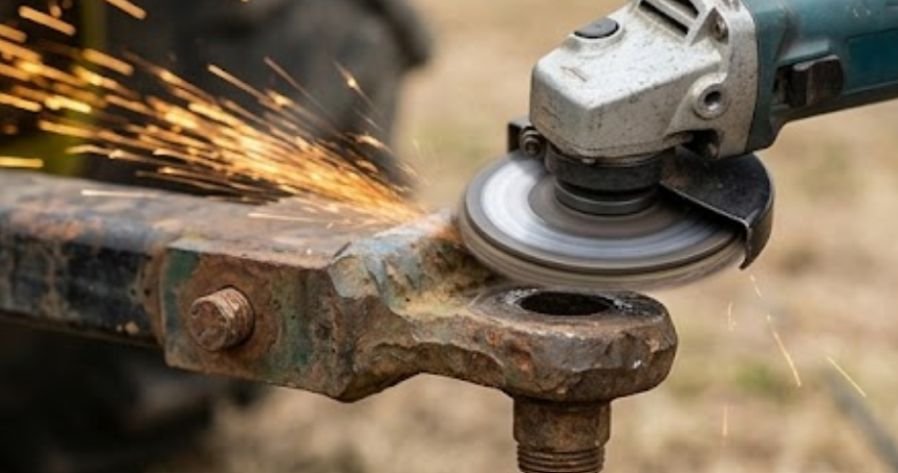
Strip the repair area down to bare, bright metal extending at least two inches back from the joint line. Use an angle grinder equipped with a coarse flap disc or wire wheel to strip away baked-on oil, field debris, and oxide layers.
2. Gouge and Bevel the Crack
Never attempt to bridge a crack by laying a bead directly over the surface rupture. You must completely excavate the defect. Use a grinding wheel or carbon-arc gouging tool to carve a “V” or “U” shaped groove along the entire crack length, reaching all the way to the root of the metal. Drill a small stop-hole at both terminal ends of the crack to prevent stress propagation while you work.
3. Protect Onboard Electronics
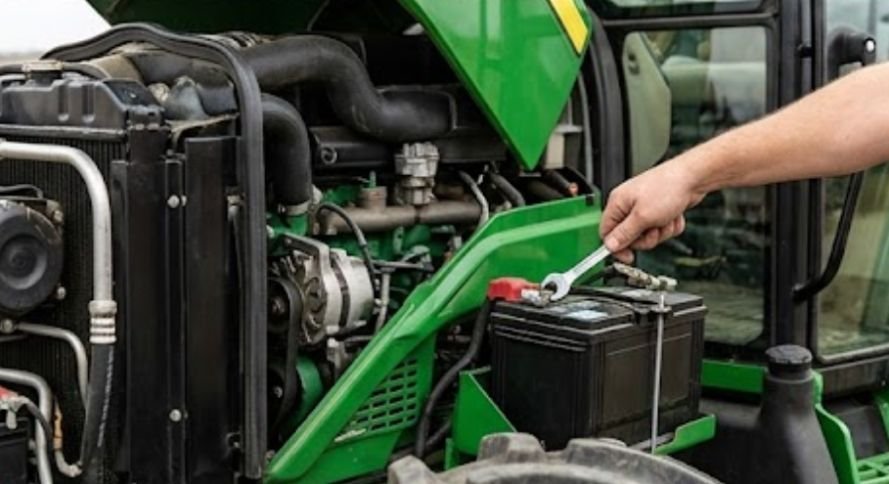
Modern tractors and self-propelled equipment rely on sensitive Engine Control Units (ECUs) and CAN bus networks. High-frequency arc starts and stray ground currents can instantly destroy these microprocessors. Always disconnect both battery terminals before striking an arc on any attached implement. Place your work ground clamp as close to the repair zone as possible to prevent electricity from traveling through hydraulic cylinders, pins, or bearings.
For comprehensive guidelines on electrical safety and machinery maintenance practices, consult the National Institute for Occupational Safety and Health (NIOSH), which tracks agricultural machinery injury and equipment handling protocols.
Matching Process to Environment: SMAW vs. GMAW
Choosing the right process for field repairs comes down to environmental factors, metal cleanliness, and structural depth.
Stick welding (Shielded Metal Arc Welding) remains the undisputed industry standard for field work. It requires no shielding gas, making it immune to wind, and its deep-penetrating flux chemistry can burn through minor surface impurities that would cause gas metal arc processes to fail. Low-hydrogen electrodes, such as E7018, deliver exceptional impact toughness and ductility on heavy structural frames, while fast-freeze electrodes like E6010 offer deep penetration for root passes in tight bevels.
MIG welding (Gas Metal Arc Welding) offers unmatched speed, clean aesthetics, and minimal post-weld slag removal. However, it requires a shop setting protected from drafts that would otherwise blow away its shielding gas. For portable shop-to-field versatility, flux-cored arc welding (FCAW) using self-shielded wire offers the speed of a continuous wire feed without requiring gas cylinders out in the pasture.
Detailed technical breakdowns of process efficiencies and electrode selection can be reviewed through research published by the United States Department of Agriculture (USDA) Agricultural Research Service.
Selecting the Right Method for the Job
| Repair Condition | Preferred Process | Recommended Filler Metal | Primary Advantage | Key Limitation |
| Outdoor / Windy Field | Stick (SMAW) | E7018 / E6011 | Unaffected by wind; high structural strength | Requires slag chipping; slower deposition |
| Indoor Shop / Sheet Metal | MIG (GMAW) | ER70S-6 | High speed; low heat input; clean beads | Requires shielded draft-free environment |
| Outdoor Fast Wire-Feed | Flux-Cored (FCAW) | E71T-11 | Fast feed rate; no external shielding gas needed | Generates heavy smoke and slag layer |
| Cast Iron Components | Stick (SMAW) | High-Nickel (Ni-Cl) | Accommodates high carbon expansion/contraction | Requires pre-heating and slow cooling control |
These process choices also depend on the type of equipment being repaired. For trailer-frame damage, the repair approach depends on the crack location, frame construction, material, and the loads the trailer is designed to carry.
Field Logistics: On-Site Mobile Service Solutions
When an equipment breakdown occurs far from the home workshop, bringing the machine back to a central facility isn’t always practical or possible. A fully equipped mobile rig provides the necessary power generation, high-amperage stick units, oxy-fuel cutting equipment, and heavy-duty air compressors to handle structural gouging on-site.
For larger machinery and complex structural damage, heavy equipment welding repair may involve crack removal, bore repair, heat control, and other specialized field techniques.
If complex repairs exceed your internal field capabilities or equipment capacity, professional local operations and specialized mobile services can provide immediate assistance. You can search verified regional providers through local business directories or learn about mobile service capabilities via Portable Welding & Fabrication for on-site repairs.
To ensure your equipment returns to full working capacity safely, follow this systematic field-repair checklist:
1.Establish Safety and Isolate Power:Crucial for electrical system protection.
Park the machine on level ground, engage parking brakes, block wheels, and fully lower implements. Disconnect both battery terminals to isolate the tractor’s ECU and onboard computer systems from electrical surges.
2.Excavate Defect and Prepare Joint:Prevents crack propagation under load.
Locate the precise origin of the crack. Drill a 1/8-inch stop-hole at each end of the crack line. Use a grinder to carve out a 60-degree V-groove down to the root of the metal, and clean bare metal 2 inches around the repair zone.
3.Apply Thermal Management:Essential for high-carbon and alloy steels.
Preheat thick structural sections using an oxy-fuel torch to between 250°F and 400°F. Preheating slows the cooling rate, preventing the formation of brittle martensite structures within the heat-affected zone.
4.Deposit Root and Pass Sequences:Ensures complete weld penetration.
Lay down a solid root pass using an appropriate electrode (e.g., E6010 or E7018). Interpass temperatures should be maintained while chipping slag thoroughly between passes. Finish with a reinforced cover pass that blends smoothly into the base metal.
Managing Cast Iron and Dissimilar Metals
Cast iron components—such as gearbox housings, manifold flanges, and antique pump casings—present unique repair challenges due to their high carbon content (typically 2% to 4%). When rapidly heated and cooled during welding, cast iron forms extremely hard, brittle microstructures that crack almost immediately upon cooling.
To successfully repair cast iron, preheat the entire component uniformly to 500°F–1,200°F before welding, use high-nickel filler rods, and implement post-weld peening with a chipping hammer to relieve internal tensile stresses. Alternatively, allow the part to cool slowly inside an insulated blanket or a bed of dry sand over several hours.
Certain high-stress structural repairs—such as hardened loader pins or heat-treated spring steel components—should never be welded directly. Joining these components destroys their factory-engineered temper and leads to sudden brittle fractures under normal operating loads. In these cases, mechanical pin replacement or complete component substitution is the safest path forward.
Educational resources on metallurgy, metal fatigue, and material strength standards are available through the Occupational Safety and Health Administration (OSHA).
Frequently Asked Questions
1. Why do structural welds on farm equipment crack right next to the repair?
Excessive heat input weakens the adjacent base metal (Heat-Affected Zone), creating a localized stress point. Rapid cooling hardens this area, making it brittle and prone to cracking under field loads.
2. Can I MIG weld a broken tractor frame out in the field?
It is not recommended. Outdoor wind disrupts the shielding gas, causing internal weld porosity and severe strength loss. Use Stick welding (SMAW) or self-shielded flux-cored wire for outdoor repairs.
3. Do I really need to disconnect the tractor battery before welding?
Yes. High-frequency arc starting and stray electrical currents traveling through the equipment frame can permanently destroy expensive engine control units (ECUs), sensors, and digital displays.
Long-Term Operational Integrity
High-quality farm equipment welding repair relies on solid metallurgical principles, thorough surface preparation, and selecting the right process for field conditions. By grinding out cracks completely, managing thermal cooling cycles, and matching filler metals to base alloys, you transform a temporary fix into a permanent structural repair.
As agricultural machinery continues to evolve with advanced high-strength alloys and complex electronic systems, adopting disciplined field repair practices ensures your equipment remains operational, durable, and safe through every season.