
I failed my first open-root plate test because I dragged a 6010 like a 7018. The instructor looked at the lack of penetration and said, “You need to whip it.” That day changed how I weld pipe. The whip and pause stick welding technique is not just a motion, it is heat control.
This is a manual manipulation method used almost exclusively in SMAW with fast-freeze cellulosic rods. It lets you get deep penetration without blowing through.
What The Whip And Pause Actually Does
Fast-freeze rods like E6010 and E6011 have a thin, fast-solidifying slag. That is the whole reason this works. When you whip forward, you pull the arc off the puddle. The puddle freezes instantly. When you pause back, you deposit metal again.
You are doing two jobs at once: digging for penetration on the whip, and filling and washing the toes on the pause. Unlike a steady drag, you control the keyhole in real time.
I learned this works best on open-root joints. If you want to see how puddle control differs in other processes, understand horizontal 2g pipe tig welding techniques.
How I Run The Whip And Pause Step By Step
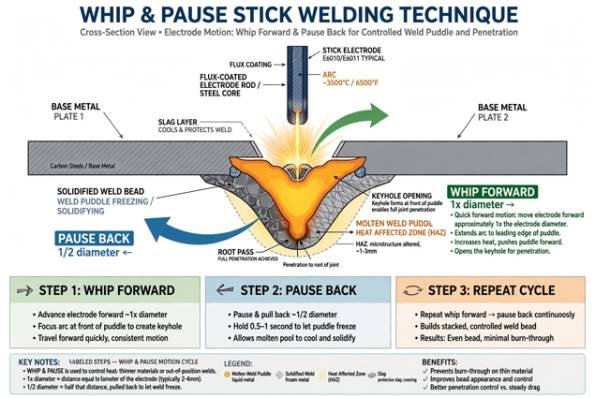
I run this with 1/8″ E6010 at 78-85 amps DCEP on 3/8″ plate with a 3/32″ gap. My motion is about one electrode diameter. Keep your arc tight.
The Forward Whip
Strike in the puddle, then flick the rod forward about 3/16″ in the direction of travel. You are not just moving, you are gouging. The aggressive arc of a 6010 opens a small U-shaped keyhole. You will hear a sharp crackle.
That forward move also removes heat from the puddle so it can solidify. If the gap gets wide, I whip a little farther. This is how you prevent burn-through.
For arc fundamentals, Miller Electric explains why arc length controls penetration in SMAW MillerWelds. Lincoln Electric also details the dig of cellulosic electrodes Lincoln Electric.
The Backward Pause
Snap back about half a diameter to the leading edge of the freezing puddle. Pause there for a half second. This is where you deposit filler, fill the keyhole edges, and tie into both sidewalls.
Do not linger in the middle or you will get a high crown. Wash the sides. You should see the puddle build and flatten.
Repeat whip-pause-whip-pause down the joint. A good bead shows distinct, tight ripples like dimes.
When You Should Use It And When You Should Never
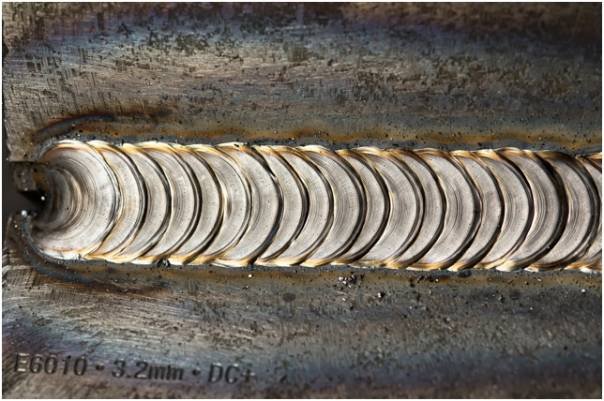
Use it for E6010 / E6011 root passes on pipe in 5G and 6G, open-root plate tests, and stick weld vertical up 7018 for vertical-up structural joints where gravity pulls the puddle. It is perfect when you need deep bite with low heat input.
Never use it with low-hydrogen or heavy slag rods. Whipping E7018, E7014, or E6013 rolls the molten puddle over liquid slag. That traps slag inside. You get inclusions and porosity that will fail bend and x-ray. The American Welding Society notes that E7018 requires a steady technique to maintain gas shielding AWS.
Electrode and Parameter Reference
I keep this table on my welding cart. It saves rods and rework.
| Electrode Type | Use Whip and Pause? | Correct Technique | Result If You Whip It |
| E6010 / E6011 | Yes – Required | Whip 1x diameter, pause 1/2 diameter | Deep penetration, stack of dimes |
| E7018 | No – Never | Steady drag, tight weave inside puddle | Slag inclusion, porosity, failure |
| E6013 / E7014 | No – Never | Light drag or slight weave | Slag entrapment, poor fusion |
| My Tested Setup | Amperage | Gap / Land | Motion |
| 3/32″ 6010 Root | 65-75A DCEP | 3/32″ gap, 1/16″ land | Whip 1/8″, Pause 1/16″ |
| 1/8″ 6010 Root | 78-85A DCEP | 3/32″ gap, 3/32″ land | Whip 3/16″, Pause 1/8″ |
| Vertical-Up 6010 | 70-80A DCEP | Tight gap | Shorter whip, longer pause |
Mistakes That Will Fail Your Weld
My first week I made every mistake. Long arc kills penetration. Whipping too far loses shielding and the keyhole collapses. Pausing in the center instead of washing the toes leaves undercut. And moving too fast leaves lack of fusion at the root.
Keep your stinger angle at about 10 degrees drag and watch the keyhole, not the bright arc. If the keyhole is the size of the rod diameter and stays open, your rhythm is right.
FAQs
1. Can you use whip and pause with 7018?
No, it traps slag and causes inclusions.
2. What is the keyhole in whip and pause welding?
It is the small U-shaped opening ahead of the puddle that shows full penetration.
3. How far do you whip a 6010 rod?
About one electrode diameter forward, then back half a diameter to pause.
4. Is whip and pause good for beginners?
Yes for 6010 roots, it teaches heat and puddle control faster than dragging.
Final Spark: Go Burn a Root That Holds
Stop dragging that 6010 like it is a 7018. Get a coupon, set 80 amps, and practice the rhythm until you hear that crackle-pause-crackle. Once you can hold a consistent keyhole, your roots will pass. Go burn one and cut it – the etch will tell you the truth.