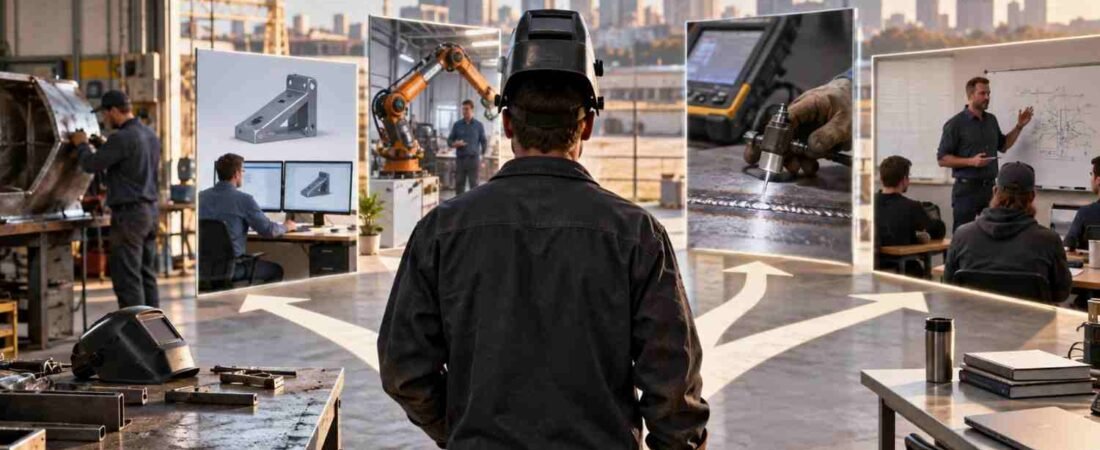
I started noticing how often welding experience shows up in jobs that do not involve spending every shift behind a welding hood. The more I looked at fabrication shops, the clearer it became that knowing how metal behaves, how drawings translate into parts, and where production can go wrong has value beyond the booth.
I also realized that technology has not simply pushed welders aside. It has created new roles for people who understand both the trade and the systems around it. For someone considering career paths beyond traditional welding jobs, that shift can mean building on practical experience instead of walking away from it.
Why welding experience still matters
Welding teaches judgment and technical discipline. Welders work with materials, measurements, tolerances, heat, distortion, joint design, safety, and production deadlines. They also learn to spot problems that may not be obvious in a drawing.
Those skills transfer well. A move into inspection, automation, supervision, or education can start with the same shop-floor knowledge.
Manufacturing is changing, too. Automation and robotics are becoming more common, creating space for workers who add digital or leadership skills to trade knowledge.
Explore technology and automation roles
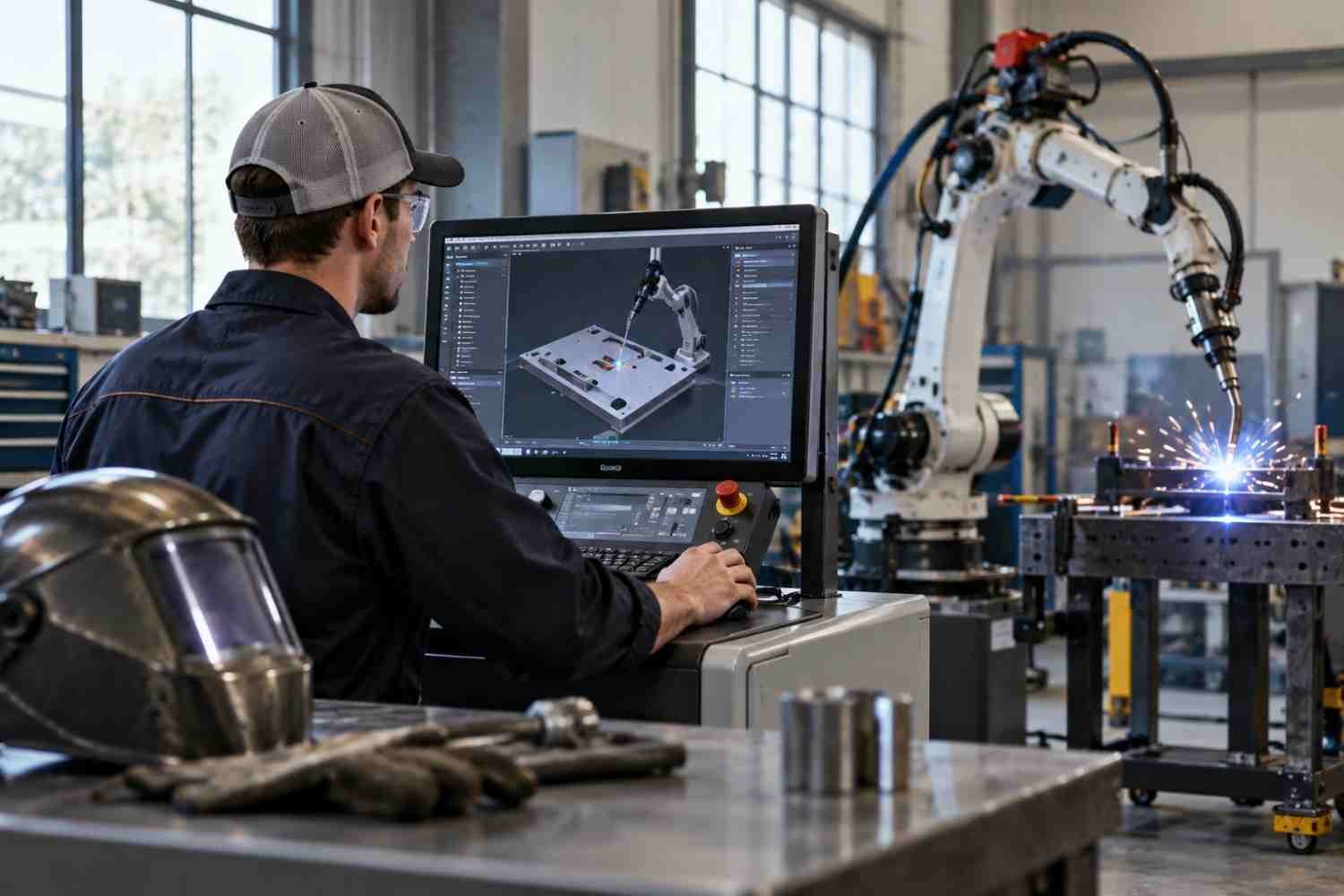
A robotic welding technician is one of the clearest career transitions. Instead of manually controlling every weld, the technician may program robotic systems, adjust parameters, troubleshoot faults, maintain equipment, and improve production consistency.
The work still depends on welding fundamentals. A robot cannot compensate for poor joint preparation or incorrect settings. That experience becomes useful when learning programming, sensors, automated cells, and production software.
Application engineering offers another route. These professionals help manufacturers choose equipment, consumables, gases, and welding processes for specific production problems. Communication matters when explaining technical options.
For welders interested in this direction, building technology skills modern welders need can make the transition more possible. Basic programming, digital documentation, equipment diagnostics, and familiarity with automated manufacturing systems can complement hands-on expertise.
Move into inspection and quality
Inspection can be a natural next step for an experienced welder who enjoys precision and problem-solving more than repetitive production work.
Certified welding inspectors examine welds, review drawings and specifications, verify procedures, and document whether work meets applicable requirements. Their experience with actual welding can help them understand why defects happen rather than simply identifying that a defect exists.
Non-destructive testing provides another related path. NDT professionals use ultrasonic testing, magnetic particle testing, liquid penetrant testing, and radiography to evaluate materials without damaging them. These skills are useful wherever structural integrity and quality control are critical.
Inspection also changes the routine, with more documentation and responsibility and less continuous torch time.
Consider specialized industries
Some welders prefer to stay technical rather than move away from fabrication. Specialized industries can provide that opportunity.
Aerospace fabrication demands tight tolerances, process control, traceability, and familiarity with materials such as aluminum and titanium. Small mistakes can have serious consequences.
Commercial diving and underwater welding combine welding knowledge with commercial diving skills for work around marine structures, vessels, and underwater infrastructure. The specialization requires additional training and safety preparation.
Custom fabrication suits people who enjoy craftsmanship. The work can include architectural metalwork, furniture, sculptures, stage pieces, or specialized structures, blending welding with design and finishing.
Step into leadership, teaching, or technical sales
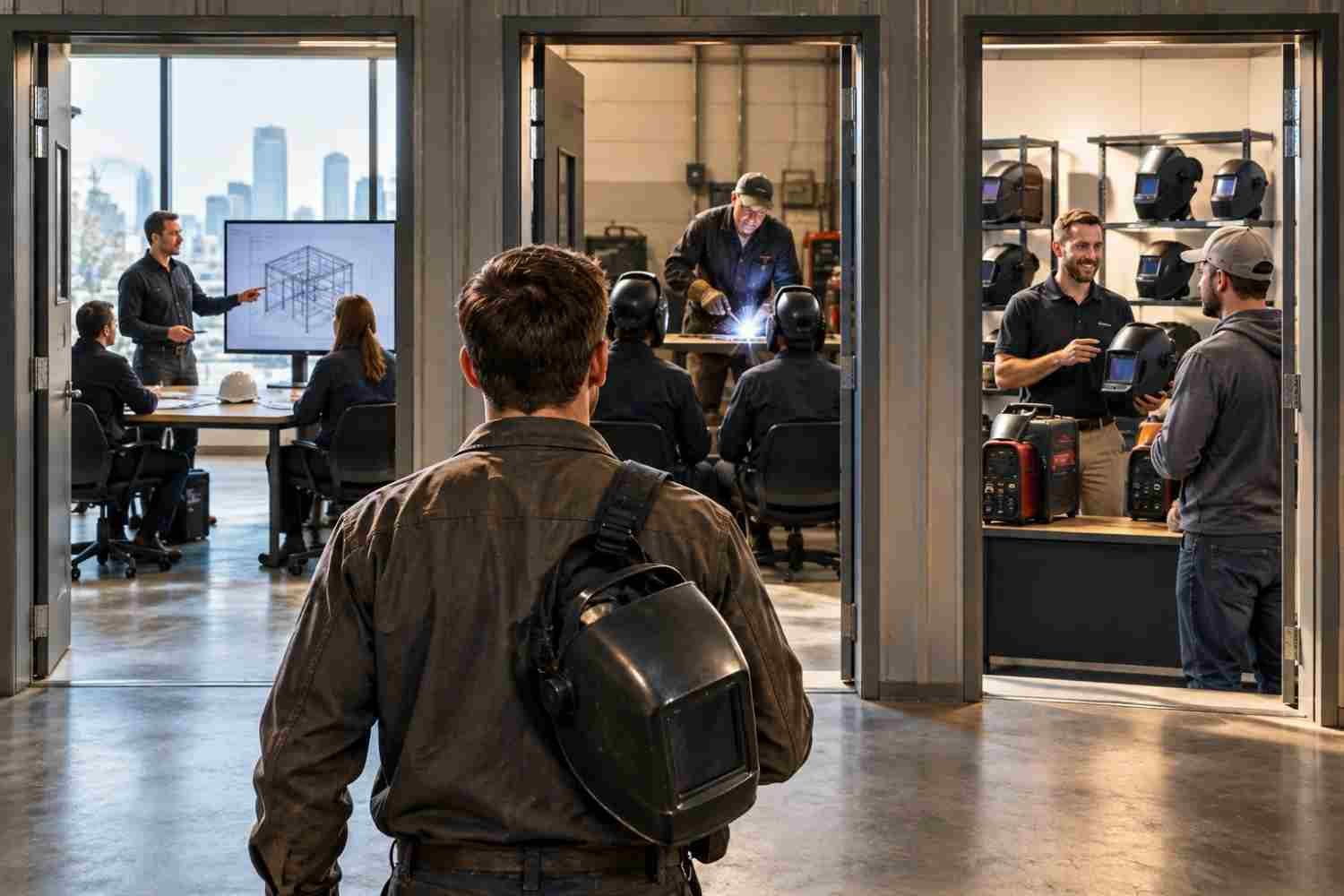
Years on the shop floor can provide a strong foundation for leadership. Welding supervisors and construction managers coordinate crews, schedules, materials, safety requirements, quality expectations, and project deadlines. Communication becomes just as important as technical knowledge.
Teaching is another option. Experienced welders can move into vocational education, apprenticeship training, or company-based instruction. The ability to explain why a technique works, demonstrate it safely, and correct mistakes is valuable in training.
Technical sales can suit welders who enjoy people as much as equipment. Product knowledge helps these professionals recommend practical solutions, while shop experience can make customer conversations more credible.
Build a practical transition plan
Changing careers does not mean starting from zero. Identify the parts of welding you know well and connect them to a new responsibility.
Someone comfortable with weld quality could investigate inspection credentials. Someone fascinated by automated cells could learn robotic programming and controls. A natural leader might explore supervision. A strong communicator could consider teaching or technical sales.
Digital confidence is useful across these options. Learning to work with production software, digital drawings, inspection records, scheduling systems, and other digital tools for modern welding professionals can make an experienced tradesperson more adaptable.
Training should be targeted. Look at job postings, note the certifications and technical skills employers repeatedly request, and build those gaps one at a time.
Choose the direction that fits your strengths
There is no single best alternative career for every welder. Someone who likes diagnosing machines may thrive in automation, while a detail-oriented worker may prefer inspection. A people-focused professional might enjoy teaching, sales, or supervision. A craft-driven welder may find satisfaction in custom fabrication.
The strongest career move preserves something you already enjoy while reducing parts of your role that no longer fit. Welding knowledge can become the foundation for a specialized role.
FAQs: Career Paths Beyond Traditional Welding Jobs in a Changing Industry
1. What careers can welders move into?
Welders can move into inspection, NDT, robotic welding, supervision, technical sales, teaching, engineering support, specialized fabrication, and project management.
2. Do I need to stop welding to advance my career?
Not necessarily. Many advanced roles build directly on welding experience while adding skills in quality, technology, leadership, or project coordination.
3. Is robotics a good option for experienced welders?
Yes. Welding knowledge provides a foundation for learning robotic programming, automated cells, troubleshooting, and production controls.
4. What skills should welders develop for new careers?
Useful additions include digital documentation, blueprint interpretation, quality systems, communication, automation knowledge, inspection methods, and leadership skills.
Let experience open the next door
The most useful way to think about career paths beyond traditional welding jobs is not as an escape from the trade, but as an expansion of it. Years spent understanding metal, equipment, drawings, defects, and production realities can become an advantage when paired with inspection credentials, automation knowledge, management ability, or stronger communication skills. The practical judgment developed on the shop floor can still be at its center.
A welding career does not have to follow one straight line. Sometimes the smartest move is to point existing skills toward a new problem worth solving today..