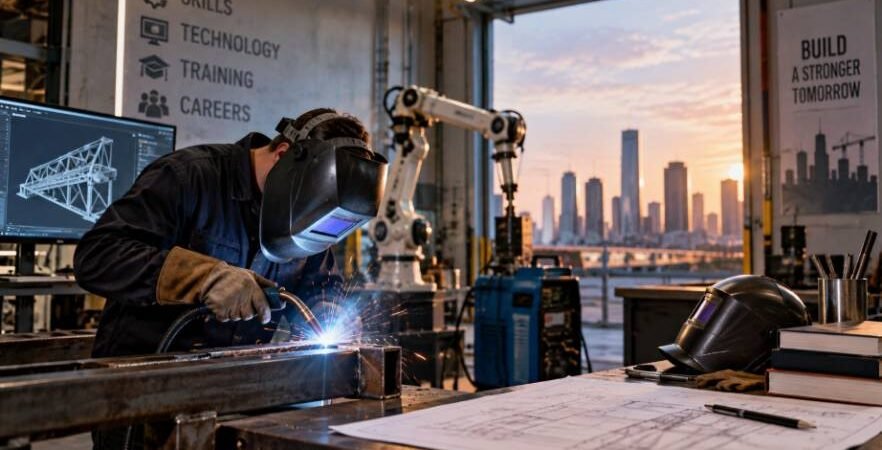
I have noticed that welding shops are changing in ways that would have seemed unusual a few years ago. A welder can spend hours fitting, tacking, and running beads by hand, but there is often a screen, sensor, robot, or digital work instruction nearby. That mix makes the future skills for the welding workforce feel less like a general idea and more like something already taking shape on the shop floor today.
I have also found that automation does not automatically make experienced welders less valuable. It can create opportunities for people who understand welding and are willing to learn technology. The strongest career path may come from combining practical craftsmanship with confidence around sophisticated equipment.
Why Welding Skills Are Changing
Manufacturers need skilled people who can produce consistent welds while meeting tighter requirements for productivity, traceability, and quality. Automation is also taking over some repetitive movements and helping companies handle higher production volumes.
Employers still need welding fundamentals, but technical curiosity is becoming an advantage. Blueprint reading, welding procedures, parameter control, defect recognition, and fit-up remain foundational alongside software, sensors, automated equipment, and digital inspection.
The future is not manual welding versus robots. It is a broader skill set in which welders, technicians, inspectors, and supervisors understand how the pieces work together.
Core Welding Knowledge Still Carries the Career
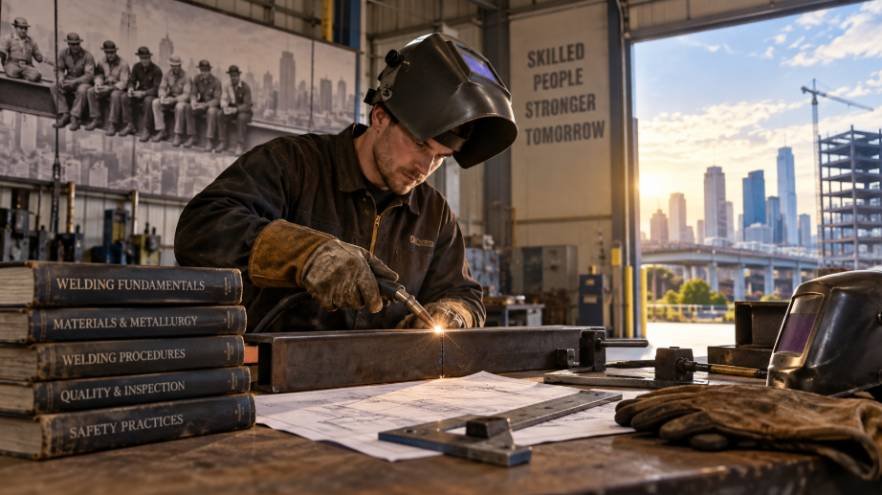
Technology cannot compensate for weak fundamentals. Long-term fabrication work requires knowledge of welding processes, joint design, base metals, filler metals, heat input, distortion, and weld quality.
Blueprint reading and welding symbols deserve particular attention. Connecting drawings to a welding procedure strengthens troubleshooting skills. Knowledge of codes, specifications, inspection requirements, and safe work practices becomes more useful as responsibility increases.
Technology Skills Are Becoming Part of the Trade
Robotic welding is one of the clearest examples. Automated cells can handle repetitive production, but someone still has to set up equipment, verify programs, monitor the process, identify problems, and keep production moving.
Workers can benefit from programming logic, sensors, machine interfaces, PLC concepts, and automated cell operation. They do not need to become software engineers. The practical goal is understanding how equipment responds.
For people interested in robotic welding career opportunities, this combination can open doors into technician, programmer, setup, maintenance, and production-support roles. It can provide a bridge from hands-on welding into higher-responsibility roles without abandoning welding knowledge.
AI and Data Are Changing How Quality Is Managed
Artificial intelligence is beginning to influence welding through machine vision, process monitoring, adaptive controls, and automated inspection.
Data literacy will become more useful. Systems may monitor travel speed, heat input, arc characteristics, or other variables. Understanding that information can help workers catch problems earlier and reduce scrap.
Every welder does not need advanced statistics or computer science. Basic comfort with digital records, measurements, dashboards, and troubleshooting can make a difference. Workers who understand both the physical weld and the data surrounding it can communicate problems more effectively.
Training Needs to Keep Pace
Training is valuable when it combines hands-on practice with modern manufacturing skills. Traditional shop experience remains essential, alongside robotic equipment, digital simulations, and newer materials.
Simulation provides a controlled environment for practice and feedback before students move to expensive materials or production equipment. Specialized programs can introduce workers to high-strength steels, titanium, aerospace components, and other demanding applications.
Certifications can demonstrate competence. Credentials such as Certified Welding Inspector can support moves toward inspection and quality, while specialized training can strengthen positions in advanced fabrication or automation. The best choice depends on experience and career direction.
Career Paths Are Becoming More Diverse
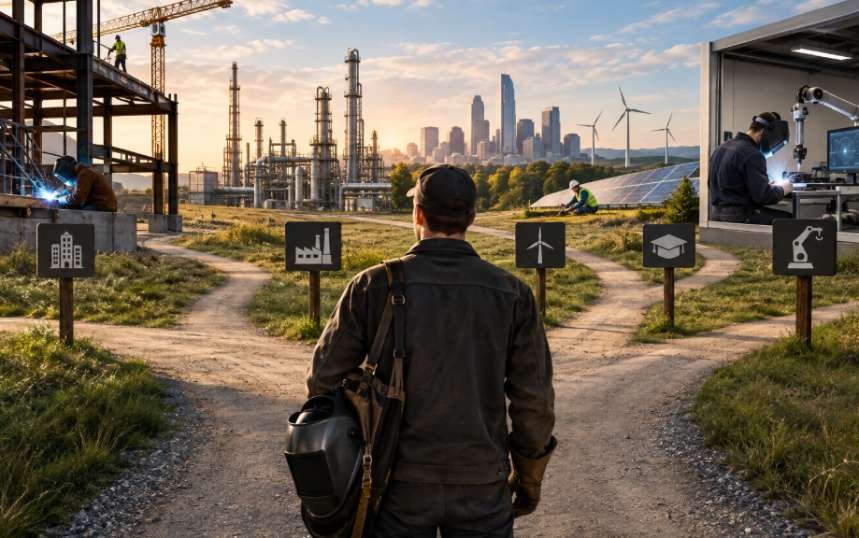
The welding trade no longer points toward one destination. Experienced welders can move toward inspection, supervision, specialized fabrication, teaching, estimating, or automation support. A worker who develops technology skills may eventually help program or troubleshoot robotic welding cells rather than spending every shift performing repetitive welds.
This progression suits people who want greater responsibility without leaving manufacturing. Practical credibility still matters in supervisory roles.
Career development works best as a series of additions: learn one process well, strengthen blueprint and code knowledge, add inspection skills, and become comfortable with digital equipment.
Adaptability May Be the Most Valuable Skill
Technology will change faster than any single training course can predict. Equipment, software, and manufacturing methods will evolve. Workers who can learn unfamiliar systems while retaining welding principles will have an advantage.
Human skills matter too. Troubleshooting, communication, attention to detail, judgment, and teamwork are difficult to replace with a machine. Automation can perform a programmed task consistently, but people still decide what should be produced, recognize unusual conditions, and respond when something falls outside the expected pattern.
For anyone exploring AI and automation in welding careers, the lesson is simple: learn enough about emerging technology to work with it rather than fear it. The goal is not to turn every welder into a programmer. It is to build a workforce capable of moving between craftsmanship, equipment, quality, and problem solving.
Building Skills That Stay Useful
Durable welding careers will likely belong to workers who keep adding useful layers to their knowledge. Manual technique provides the base, while blueprint reading, metallurgy, inspection, digital tools, robotics, and process data build on it. Training becomes less about collecting certificates and more about handling situations that require several skills at once.
No checklist guarantees a long career, and technology will keep changing the answer. Still, welding professionals who stay curious and learn to work alongside advanced equipment can remain valuable as manufacturing evolves.
A small investment in learning can change the kind of work you qualify to do. The future belongs less to people who avoid technology than to those who can make technology work with good welding judgment.
Frequently Asked Questions
1. Will robots replace welders?
Robots are more likely to change welding jobs than eliminate skilled workers. People still handle setup, programming, troubleshooting, inspection, fit-up, and unusual production problems.
2. What technology skills should welders learn?
Start with computer literacy, digital welding controls, sensors, programming logic, PLC concepts, and robotic cell operation. The right depth depends on the role and employer.
3. Are welding certifications still valuable?
Yes. Certifications can demonstrate competence and support moves into inspection, specialized fabrication, quality, or supervisory work. They are most useful when paired with practical experience.
4. How can a welder prepare for automation?
Build strong welding fundamentals first, then seek exposure to robotic systems, simulations, digital monitoring, and automated inspection. Continuous learning is more useful than relying on one credential.