Choosing the best welder for car body panels is less about maximum amperage and more about control. Thin automotive sheet metal can burn through or distort quickly, so I look for a machine that runs smoothly at low settings, feeds small-diameter wire consistently, and lets me manage heat without fighting the arc.
For most US DIY restorers and home-garage users, a gas-shielded MIG welder is the most practical starting point.
What Type of Welder Works Best on Car Body Panels?
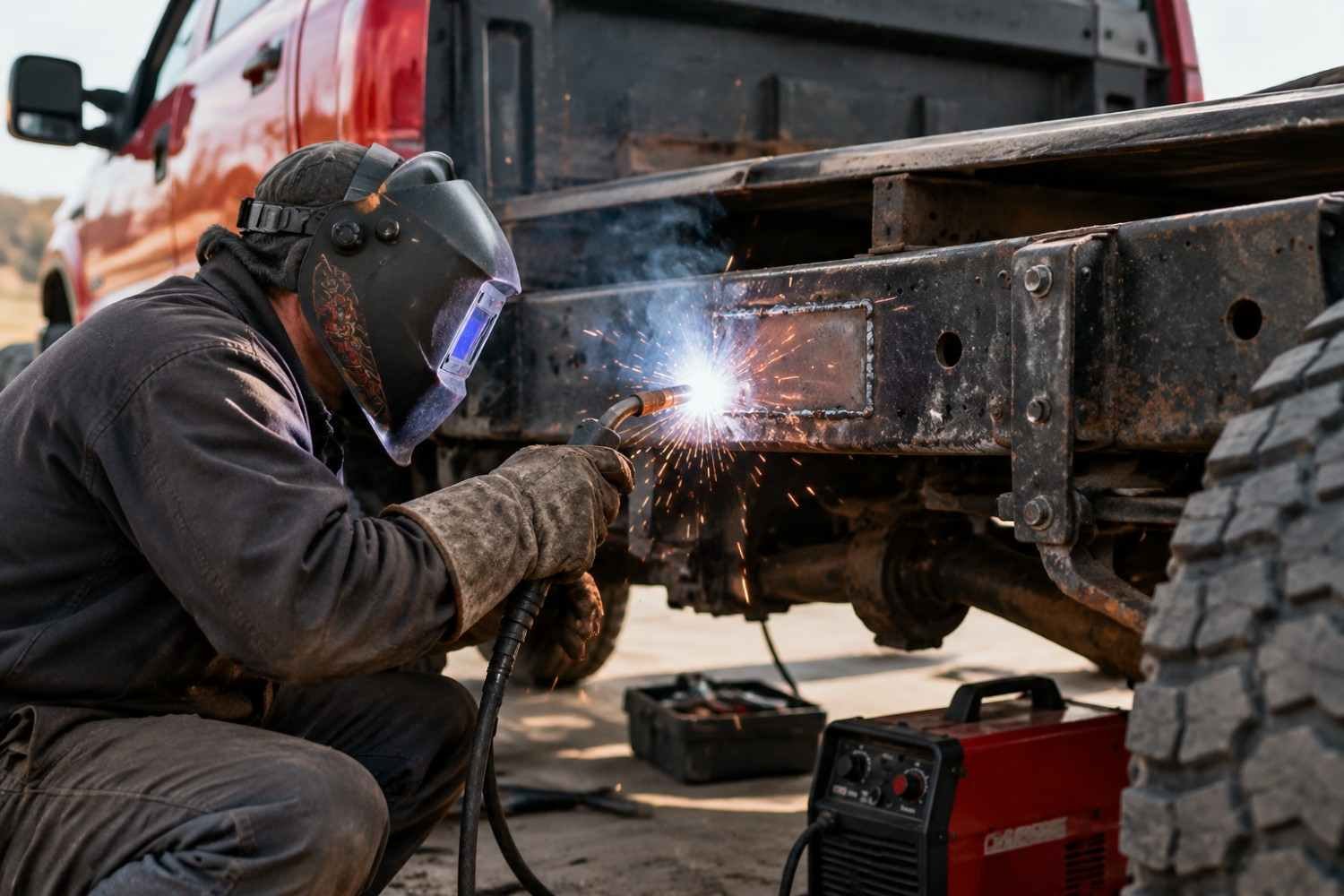
For typical mild-steel bodywork, I prefer MIG welding because it is easy to tack and well suited to patch panels, rocker panels, floor pans, door skins, fenders, and quarter panels. A 120V MIG machine can handle much of this work when it has good low-end control. The same attention to wire diameter that matters when choosing the best wire size for MIG welding exhaust also helps with body panels, where excessive heat can quickly cause burn-through or distortion.
TIG offers excellent precision for restoration, stainless, or aluminum, but it takes more skill. Self-shielded flux-core can weld steel, yet I would not choose it first for cosmetic automotive sheet metal because it produces more spatter.
Which MIG Welders Are Strong Choices for Auto Body Work?
The Hobart Handler 140 is a practical choice for a traditional US home garage. It is straightforward, works with small solid wire, and suits thin sheet metal plus occasional thicker mild-steel jobs.
The Miller Millermatic 211 PRO fits buyers who want room to grow. Its dual-voltage design supports 120V garage use while adding 240V capability for heavier fabrication.
For a budget-oriented machine with more automation, the ARCCAPTAIN MIG200P stands out. It combines Pulse MIG with synergic control. Pulse MIG modulates current to improve heat management, while its synergic system automatically coordinates voltage and wire-feed speed from selected parameters. That gives beginners a useful starting point while still allowing manual adjustments.
The Eastwood MIG 140 is another compact 120V option for sheet-metal repair. Across all these machines, stable low-end performance matters more than headline amperage.
Is Pulse MIG Better for Thin Automotive Sheet Metal?
Pulse MIG can help when heat control is a priority. Instead of keeping current constant, it alternates between higher and lower current, which can reduce overall heat input and spatter in suitable applications.
Pulse still cannot replace good technique. Thin panels can warp if I stay in one area too long, so careful tack placement and cooling remain essential.
What Wire Size Should I Use for Car Body Panels?
For thin mild-steel automotive panels, I generally use .023- or .024-inch ER70S-6 solid wire. Smaller wire melts with less current and gives me finer control over a small weld puddle.
I would not say .030-inch wire can never be used. It can work on some repairs, especially as material gets thicker. However, .023 or .024 wire is usually easier to manage on thin 18- to 22-gauge steel. I would reserve .035 wire for thicker work.
For shielding gas, a 75% argon and 25% CO2 blend, commonly called C25, is a widely used choice for mild-steel MIG welding because it supports a smooth arc and relatively clean weld.
How Do I Prevent Burn-Through and Panel Warping?
The biggest mistake in thin-panel welding is running a long continuous bead. That concentrates heat and can cause shrinking, buckling, or visible distortion.
Instead, I use a stitch-welding approach. I place a quick tack, or “zap,” then move to another part of the seam. After the area cools, I return and gradually fill the spaces between previous tacks. Distributing the welds keeps heat from building in one location.
I also test settings on scrap steel of the same thickness first. Manufacturer charts are only starting points because fit-up, cleanliness, wire stickout, travel speed, and the individual machine can change the ideal setting.
Is a 120V Welder Enough for Auto Body Repair?
For most non-structural body-panel work, yes. A quality 120V gas MIG welder can handle rust patches, floor pans, fenders, and similar repairs.
Dual voltage makes more sense if I also weld thicker brackets or fabrication projects.
Should I Use Flux-Core Wire on Car Body Panels?
Flux-core is possible, but I would not call it ideal for thin cosmetic sheet metal. Gasless flux-core is convenient outdoors, but it usually produces more spatter and makes delicate heat control more difficult.
When shielding gas is available, solid-wire MIG is the cleaner choice for most auto body work because it makes small tack welds and finishing easier.
What Features Matter Most in an Auto Body Welder?
I prioritize stable low-amperage output, consistent wire feeding, compatibility with .023/.024 solid wire, adjustable voltage and wire speed, and a shielding-gas connection. Pulse MIG and synergic control are useful bonuses, especially for beginners.
I also prefer machines with easy-to-find US consumables and replacement parts.
FAQs About Welding Car Body Panels
1. Is MIG or TIG better for auto body work?
MIG is usually the better starting point for DIY body repair because it is faster and easier to learn. TIG offers greater precision but requires more skill.
2. Should I use .023 or .030 MIG wire for body panels?
I prefer .023 or .024 solid wire for very thin panels because it gives me finer heat control. .030 wire can still work on somewhat thicker automotive steel.
3. Do I need 240V for car body welding?
Usually not for basic sheet-metal repair. A suitable 120V MIG welder can handle many body-panel jobs, while dual voltage helps if I also weld thicker material.
Final Verdict
For most US home garages, I would choose a gas MIG machine with excellent low-end control before chasing maximum output. Pulse MIG and synergic controls can make setup easier, but wire choice and technique remain just as important.
Ultimately, the best welder for car body panels is the machine that lets me create small, controlled welds without blowing through or overheating the surrounding steel. This type of precision is similar to welding for surgical sutures, where careful control and accuracy matter more than simply applying more heat. Pair it with .023/.024 ER70S-6 wire, C25 shielding gas, clean fit-up, and patient stitch welding for a much better foundation for clean automotive sheet-metal repairs.