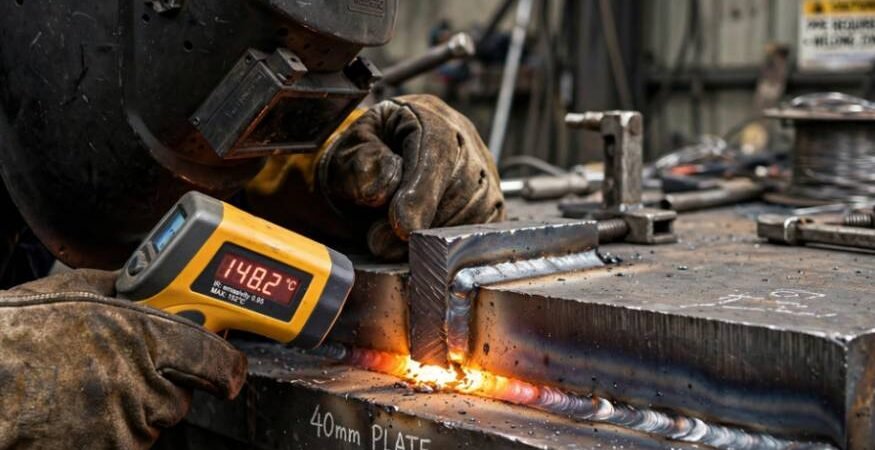
I ruined a 40mm test coupon early in my career because I ignored interpass temperature control welding thick steel. The root passed inspection. The cap cracked overnight. Thick steel acts as a massive heat sink, and if you let it get too cold or too hot between passes, you lose toughness, strength, and the whole joint.
That failure taught me to treat interpass as a window, not a single number.
Why Thick Steel Is Different For Interpass Temperature
Thin sheet sheds heat slowly. Thick plate pulls heat out fast. That rapid cooling drives hard, brittle microstructures in the heat-affected zone. Slow cooling from too much retained heat does the opposite – it coarsens grains.
This is why preheat and interpass temperature must be controlled together. Preheat starts the joint right. Interpass keeps it right. According to the American Welding Society Structural Code, interpass must be monitored for all qualified procedures on thick sections.
The Two Limits You Must Hold – Minimum vs. Maximum Interpass
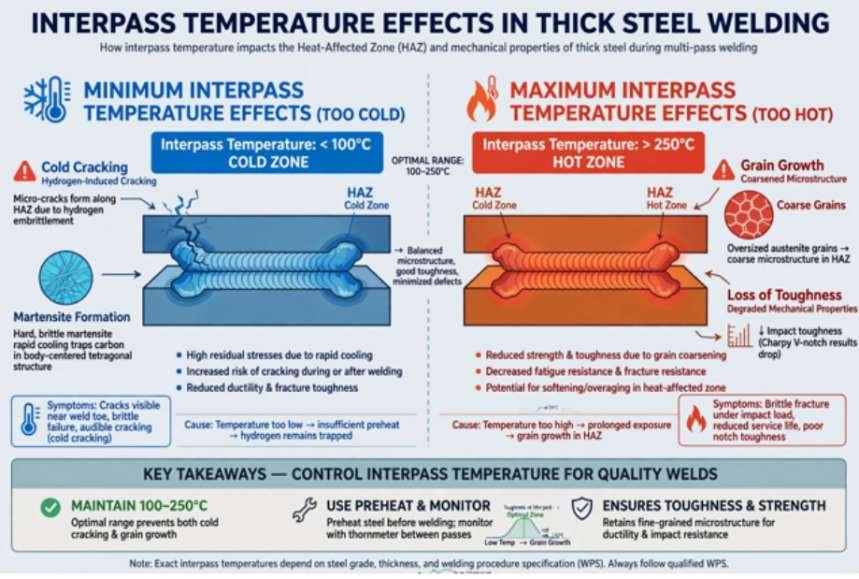
I check both before striking every pass.
Minimum Interpass – Stopping Cold Cracking
Minimum is usually your minimum preheat. You hold above it to slow cooling. Slow cooling prevents martensite formation and lets hydrogen escape. Drop below it on thick steel and you invite hydrogen-induced cold cracking. TWI Global explains how hydrogen cracking risk rises with fast cooling and thick restraint.
Maximum Interpass – Stopping Grain Growth And Softening
Maximum stops you from cooking the steel. If you stay too hot, cooling becomes too slow. Grains grow large in the HAZ. You lose yield, tensile, and Charpy V-notch impact toughness. For quenched and tempered steels, you erase the original heat treatment. As noted by The Fabricator on preheat and interpass definitions, excessive interpass is just as damaging as no preheat.
Where And How I Measure Interpass Temperature
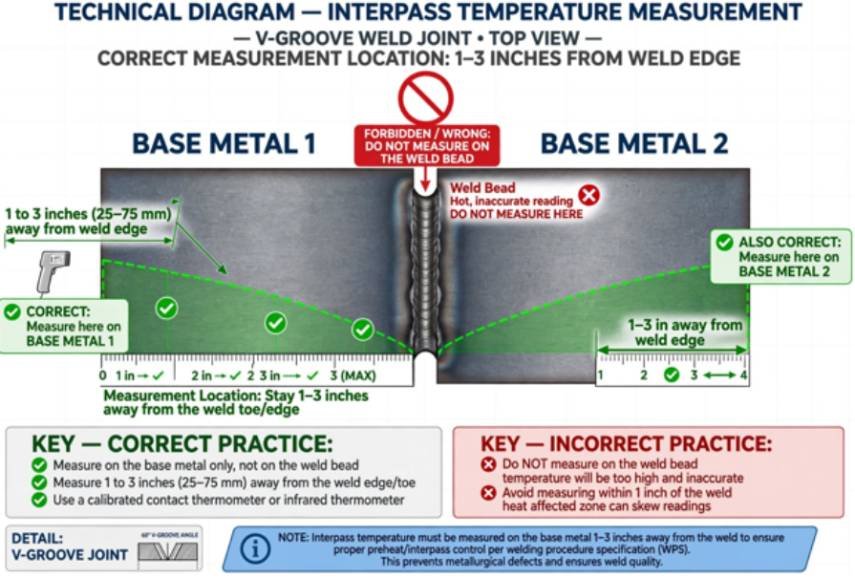
Code inspectors fail you on location, not just temperature.
The Right Location
I measure on the base metal, 1 to 3 inches from the joint edge, right before the next pass. Never on the weld bead or slag. That reading is false high. Lincoln Electric’s preheat and interpass guide shows the same measurement zone.
My 3 Tools For The Job
| Tool | When I Use It | Accuracy |
| Tempilstik crayons | Daily shop work, dirty surfaces | Very high, go/no-go |
| IR thermometer gun | Quick checks on large assemblies | Moderate, needs emissivity correction |
| Contact thermocouple | Code jobs, data logging | High, continuous |
If you work with thin sections, the logic flips. You worry about burn-through, not cracking. That’s where you need to control heat input on thin sheet metal mig welding instead of holding heat in.
What I Do When Plate Exceeds Maximum Interpass
On thick plate with many passes, heat builds. When I exceed the maximum, I stop. I let the joint air cool naturally. I never use water or forced air. Quenching creates a hard, brittle layer that cracks immediately. I also sequence my welds to spread heat, often using backstep welding technique to prevent distortion on long thick joints.
Interpass Temperature Table By Steel Type
Always follow your WPS. This is my reference for initial setup.
| Steel Type | Typical Minimum Interpass | Typical Maximum Interpass | My Key Failure Mode |
| Carbon-Manganese Structural – A36, A572 | 50°F – 300°F / 10°C – 150°C, rises with thickness | 550°F / 290°C | Cold cracking below min |
| Quenched & Tempered High-Strength – A514, S690Q | 200°F – 300°F / 93°C – 150°C | 400°F – 450°F / 200°C – 230°C | Loss of Q&T properties above max |
| Low-Alloy Chrome-Moly – P11, P22, 4130 | 300°F – 500°F / 150°C – 260°C | 600°F – 700°F / 315°C – 370°C | Deep hardenability cracking |
My Real Example: 40mm Carbon Steel Joint
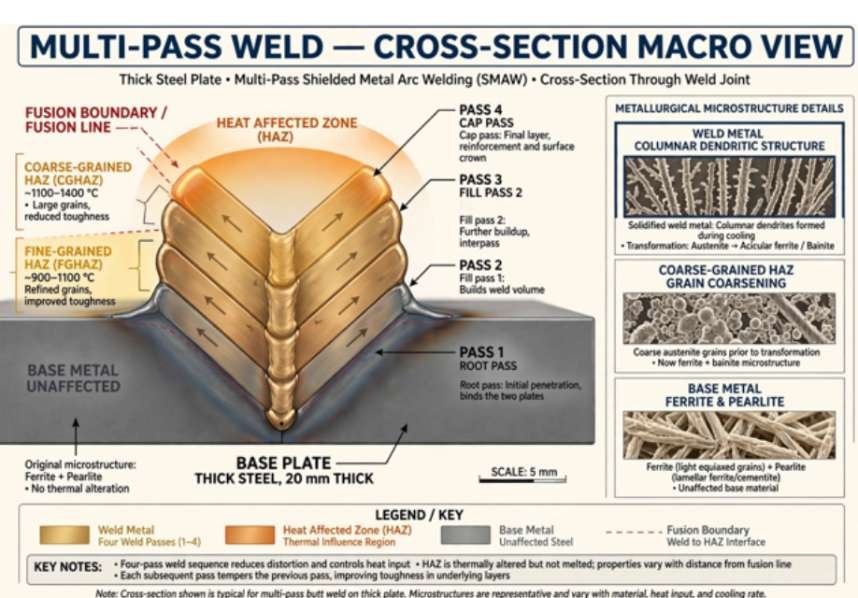
On a 40mm A572 Grade 50 double-V joint with 0.45% carbon equivalent, my WPS called for 225°F min / 450°F max. I used SMAW with 1/8″ E7018.
After pass 3, plate temp 1 inch away was 410°F. After pass 6, without pause, it hit 485°F – over max. I stopped for 8 minutes. Air cool brought it to 430°F. I resumed. Total interpass drop between passes on that thickness was about 90°F per minute at 70°F ambient.
If I had kept welding hot, my impact values at 0°F would have dropped by an estimated 25-30%. If I had let it drop to 150°F, I would have risked overnight toe cracks. The window is the work.
Frequently Asked Questions
1. What is the ideal interpass temperature for 1-inch thick steel?
Typically 200°F – 300°F minimum and under 550°F maximum for carbon steel, but check your WPS for exact CE.
2. Can interpass be too high when welding thick steel?
Yes, too high causes grain growth and loss of toughness and strength.
3. Where do you measure interpass temperature on thick plate?
On base metal 1-3 inches from the joint, before the next pass, not on the weld.
4. Is interpass temperature the same as preheat?
Minimum interpass often equals minimum preheat, but maximum interpass is a separate upper limit.
Final Word
Thick steel will punish laziness. It will suck heat out and crack, or hold heat in and soften. Hold your window, measure in the right place, and never quench. Do that and interpass temperature control welding thick steel becomes routine, not rescue.