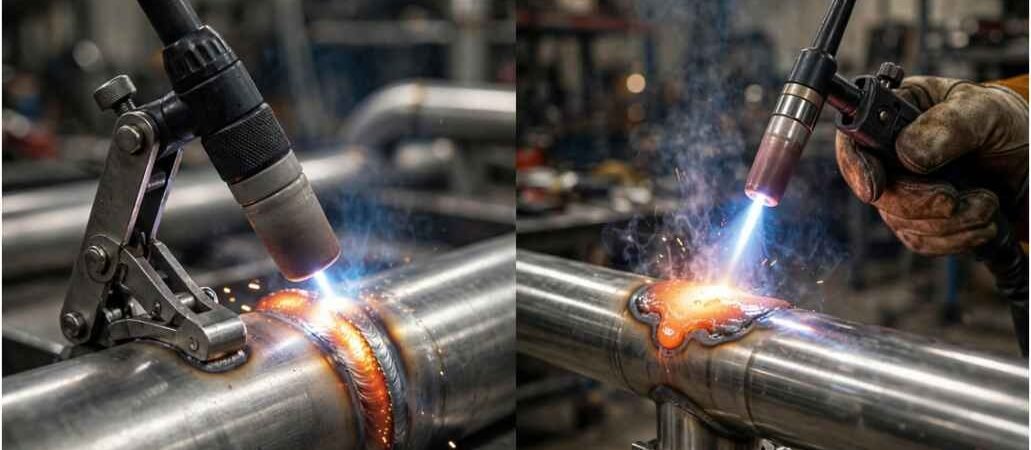
When I struck my first pipe arc decades ago, my instructor gave me clear advice: your torch manipulation dictates whether a weld passes an X-ray or fails visual inspection within five seconds.
Choosing between tig welding walking the cup vs freehand defines how you manage arc length, travel speed, surface cosmetics, and physical fatigue.
Both styles provide reliable puddle control, but applying the wrong technique in field conditions leads directly to contaminated joints or failed cutouts.
Torch Manipulation Mechanics: What Separates Both Methods
Understanding the physical interaction between your torch nozzle and the parent metal reveals why each discipline behaves differently under high heat.
WALKING THE CUP FREEHANDING
(Mechanical Pivot on Joint) (Hovering with Hand Prop)
Torch Body / Handle Torch Body / Handle
| |
| |
[ Ceramic ] <— Rests on metal [ Ceramic ] <— Hovers 1/16″-1/8″
/ \ (Walks side-to-side) / \ above surface
/ Tungsten\ / Tungsten\
+—–+—–+ +—–+—–+
===/==== Puddle ===\=== ===/==== Puddle ===\===
Parent Metal Bevel Parent Metal Plate
[ Hand / Finger Prop ]
Walking the Cup Mechanics
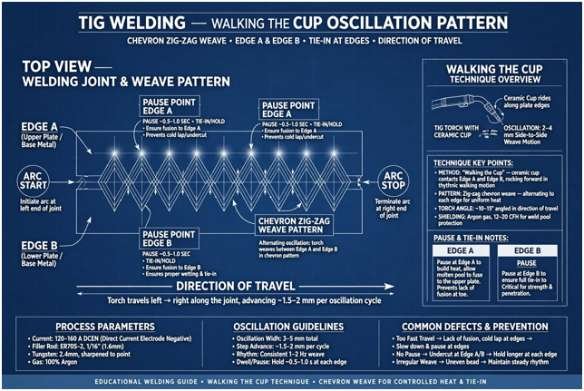
Walking the cup relies on resting the ceramic nozzle directly on the beveled joint and oscillating the torch body forward. Think of it like rolling an empty barrel across a warehouse floor. By rolling the nozzle side to side across the bevel edges, you advance the tungsten across the root or cap without lifting the cup off the steel.
Industry guidelines from Miller Electric highlight that mechanical contact locks in a fixed tungsten stand-off distance. This eliminates puddle tremors caused by hand fatigue. When I run fill and cover passes, this consistent motion creates a distinctive chevron weave with uniform edge tie-ins.
Freehanding Mechanics and Finger Propping
Freehand welding requires hovering the torch nozzle 1/16 to 1/8 inch off the workpiece without letting the ceramic touch the parent metal. Instead of rolling the torch, you stabilize your hand by sliding an insulated knuckle or resting a pinky on the surrounding plate.
This method relies entirely on fine motor dexterity. While walking the cup forces a wide weave, freehanding allows pinpoint puddle placement. You can run stringer beads, dab filler with tight rhythm, or navigate complex profile angles without requiring a bevel track to support the ceramic nozzle.
Direct Comparison: Walking the Cup vs Freehand
| Critical Variable | Walking the Cup | Freehanding |
| Torch Support | Ceramic cup rests on and pivots across the metal | Torch hovers; hand or pinky props on adjacent material |
| Bead Profile | Wide, uniform weave or chevron pattern | Tight stringer beads or subtle crescent dips |
| Arc Length Stability | High; mechanically locked by cup geometry | Moderate; relies on motor control and muscle memory |
| Clearance Required | Substantial; requires minimum 3–4 inches to swing the back cap | Minimal; fits wherever the torch body can squeeze |
| Surface Finish | Leaves abrasive scuff marks and alumina traces | Zero surface contact; leaves parent metal pristine |
| Operator Fatigue | Low; pipe bears torch weight during long runs | High; arms and hands carry torch weight |
| Standard Applications | Heavy-wall carbon/stainless pipe, flanges, 2G/5G/6G joints | Sanitary food/dairy tubing, sheet metal, mirror passes |
Walking the Cup in Heavy Industrial Pipe Spooling
Industrial pipe welding relies heavily on walking the cup. When preparing pipe runs, welders combine this motion with established horizontal 2g pipe tig welding techniques to ensure proper groove fill and avoid slump on fixed horizontal lines.
Cup Walking Oscillation Pattern:
Edge A \ / / / / (Pause slightly to tie in)
\ / \ / \ / \ /
\/ \/ \/ \/
Edge B / / / / (Pause slightly to tie in)
——————->
Direction of Travel
Resting the cup provides distinct advantages on long runs:
- Ergonomic relief: The joint carries the weight of the torch head and heavy power cable, cutting hand strain during ten-hour shifts.
- Defect reduction: Maintaining fixed tungsten extension prevents accidental dipping into the molten puddle.
- Controlled edge tie-ins: The side-to-side pause prevents undercut along the groove edges.
However, walking the cup demands clearance. If conduit, hangers, or wall framing sit within three inches of your torch cap, you cannot swing the torch handle. In these tight conditions, attempting to walk the cup leads to jerky motions, erratic shielding gas coverage, and porosity.
Freehand TIG for Tight Clearances and Sanitary Tubing
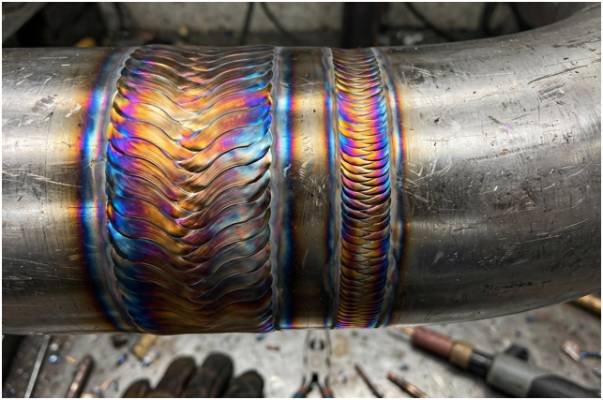
Freehand technique solves the physical limitations of walking the cup. When welding sanitary stainless tubing for breweries, dairies, or pharmaceutical plants, walking the cup is strictly unacceptable.
Ceramic cups (aluminum oxide) leave minute microscopic scuffs and trace deposits across stainless steel. In sanitary processing, these micro-abrasions harbor bacterial colonies and fail visual quality inspections. Freehanding preserves the factory pickling and electropolished finish of the parent tubing.
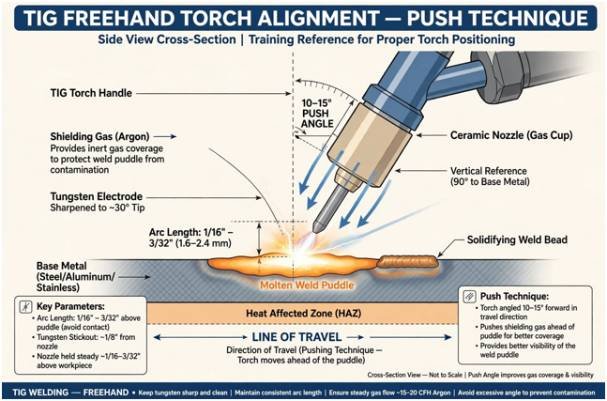
Freehand Torch Alignment:
Torch Line of Travel —>
\
\ (10°-15° Push Angle)
\
+—–[Nozzle]—–+
| \ Tungsten | <— Keep arc length 1/16″ to 3/32″
——+——\———–+——
Base Metal \ (Puddle)
——————————–
Freehanding also gives you full control over heat input. By moving quickly with stringer beads rather than wide weaves, you limit the heat-affected zone (HAZ). This prevents chromium carbide precipitation in austenitic stainless alloys. Much like managing heat buildup with the flux core vertical up shelf building technique on thick structural plate, freehand TIG lets you freeze the puddle rapidly on out-of-position joints.
How to Choose the Right Technique for Your Joint
Deciding which method to run comes down to three main factors: specification requirements, joint geometry, and clearance.
| Job Scenario | Recommended Method | Technical Justification |
| Schedule 80 Carbon Pipe Butt Weld | Walking the Cup | Maximizes travel consistency, root fusion, and uniform cover-pass aesthetics. |
| 1.5″ Thin-Wall Stainless Sanitary Tube | Freehanding | Eliminates surface abrasions, prevents burn-through, and limits heat input. |
| Boiler Tube Wall with 2″ Obstruction | Freehanding | Accommodates cramped clearance where torch handles cannot swing or roll. |
| Structural Plate Heavy Fillet (3F/4F) | Walking the Cup | Maintains uniform wash along both legs without arm tremor or uneven fill. |
| Sheet Metal Automotive Body Panels | Freehanding | Stringer beads prevent warping and burn-through associated with weave patterns. |
Review your Welding Procedure Specification (WPS) and consult standards from organizations like the American Welding Society before choosing your technique. Many high-purity aerospace and pharmaceutical codes forbid resting nozzles directly on the workpiece.
In contrast, heavy industrial pipe specifications often encourage walking the cup for cap passes. For further insights on field techniques, Lincoln Electric covers detailed torch control standards in their training literature.
Frequently Asked Questions
1. Does walking the cup damage pipe base metal?
Yes, abrasive ceramic nozzles leave light surface scratches and ceramic traces that violate visual inspection on cosmetic and sanitary stainless jobs.
2. Can you walk the cup on aluminum?
No, soft aluminum gouges easily under ceramic pressure and thick surface oxides require strict arc hovering rather than contact weaving.
3. Which technique produces stronger welds?
Both techniques deliver identical mechanical tensile strength when executed to procedure; technique selection impacts ergonomics and clearance rather than metallurgy.
4. What cup size is best for walking the cup?
A #7 or #8 ceramic cup with a gas lens provides an optimal pivot radius and gas envelope for standard pipe bevels.
Put Fire to Metal: The Verdict
Relying on only one torch manipulation method leaves half your fabrication skills on the bench. Use walking the cup when you have wide bevels, heavy wall thickness, and open swing clearance to lay down smooth cover passes without fatigue. Switch directly to freehanding the moment you hit tight mechanical rooms, thin tubing, or surface-critical stainless steel.
For your next training session, set up an open-root 6-inch pipe coupon. Run your fill passes freehand with a propped finger, then cap the joint by walking a #8 cup. Comparing both passes will reveal how torch manipulation directly shapes your bead width, cycle time, and physical endurance under the hood.
For a clear visual comparison of these distinct torch manipulations and their resulting weld beads side by side, check out Walking the Cup VS Freehand. This video demonstrates the precise mechanical pivot of walking the cup alongside the steady hover control required for freehanding.