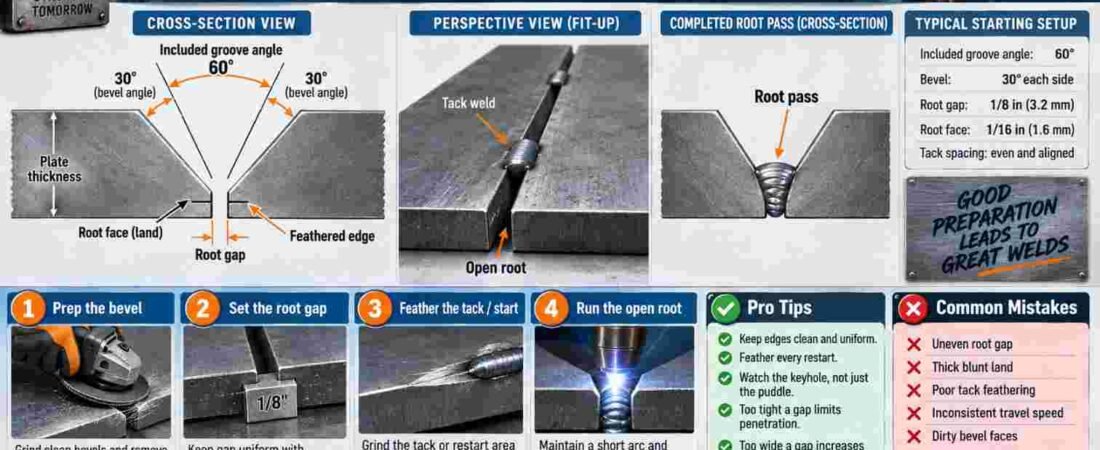
I learned butt joint bevel root gap feathering technique the hard way — after failing a 6G pipe test. The inspector showed me a line of lack-of-fusion right where my tack weld sat. Since then I have run over 200 open roots on plate and pipe, and feathering is non-negotiable for me.
If you want 100% penetration without voids, you need to understand how joint prep and tie-in work together. Here is exactly how I do it.
What This Joint Setup Actually Means
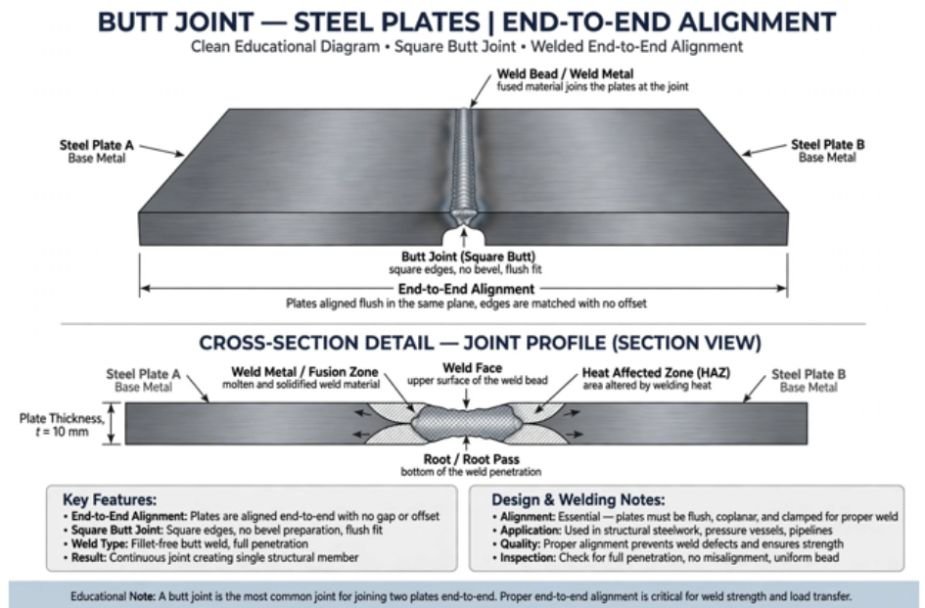
A good root starts long before you strike an arc. The fit-up decides if you even have a chance.
Butt Joint and Why Bevel Angle Matters
A butt joint puts two pieces end-to-end in the same plane. For anything thicker than 1/8″, we bevel the edges. I grind a 30° to 37.5° angle per side. Put two together and you get a 60° to 75° included V-groove.
That angle gives the arc access to the full thickness. According to Miller’s Guide to Basic Weld Joints, the five joint types all rely on this access principle to achieve fusion.
Too narrow and your rod can’t reach the root. Too wide and you burn through filler and time.
Root Gap and Root Face Explained
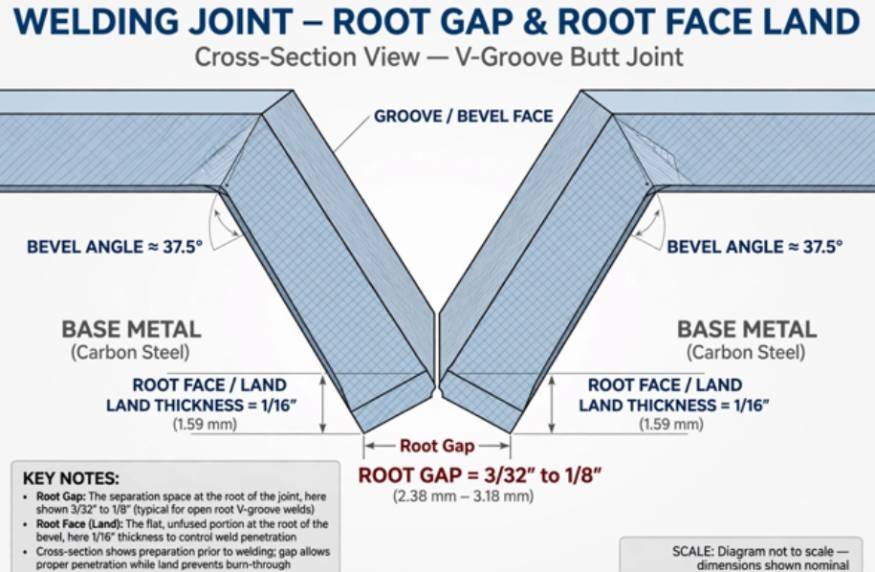
Root gap is the space you leave between plates. I run 3/32″ for TIG on pipe, 1/8″ for stick 6010. That opening lets the puddle flow to the back side.
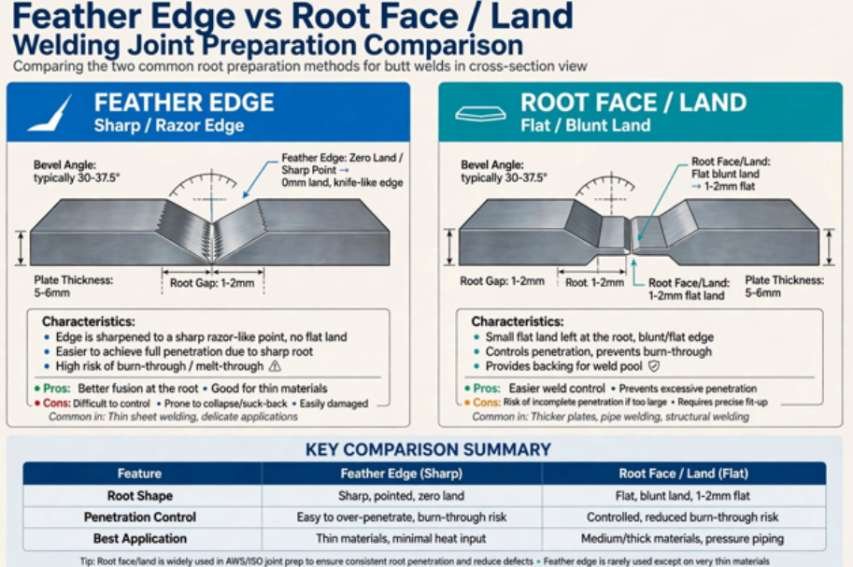
Then you choose your edge: root face (land) or feather edge. A land is a small flat, about 1/16″ (1.6mm), left on the bevel tip. It stops burn-through. A feather edge is ground razor-sharp with no land. I use feather edges only on thin wall tubing where I need full fusion fast.
TWI Global defines butt weld preparation standards that include both land and gap dimensions for controlling penetration.
| Joint Feature | My Standard Setting | Purpose | What Happens If Wrong |
| Bevel Angle | 30° – 37.5° per side | Creates V-groove for arc access | <30° = lack of fusion, >37.5° = excess filler |
| Root Gap | 3/32″ – 1/8″ (2.4-3.2mm) | Allows backside reinforcement | Too small = no penetration, too large = burn-through |
| Root Face / Land | 1/16″ flat | Prevents sagging and blow-out | No land = hole, too big = incomplete penetration |
Why Your Root Pass Cracks Without Feathering
Here is the problem no one shows in photos. When you stop welding, the puddle freezes as a thick bump. If you start your next bead right on top of that bump, your arc rides over it instead of melting it. That is textbook lack-of-fusion.
I tested this on two identical coupons. Coupon A I welded over an un-feathered tack. Coupon B I feathered. Coupon A failed bend test at the tie-in. Coupon B passed. The difference was a 30-second grind.
Feathering tapers that bump into a thin ramp. Thin metal melts easy. Thick metal doesn’t. The feathered ramp lets your new puddle consume the old one completely. AWS forum discussions on tie-in failures consistently point to un-feathered stops as the root cause.
If you are moving from open roots to other positions, learning to weld open root pass with tig lay wire technique will make your feathered tie-ins even smoother because you control heat separately.
How I Feather Tack Welds for a Perfect Tie-In
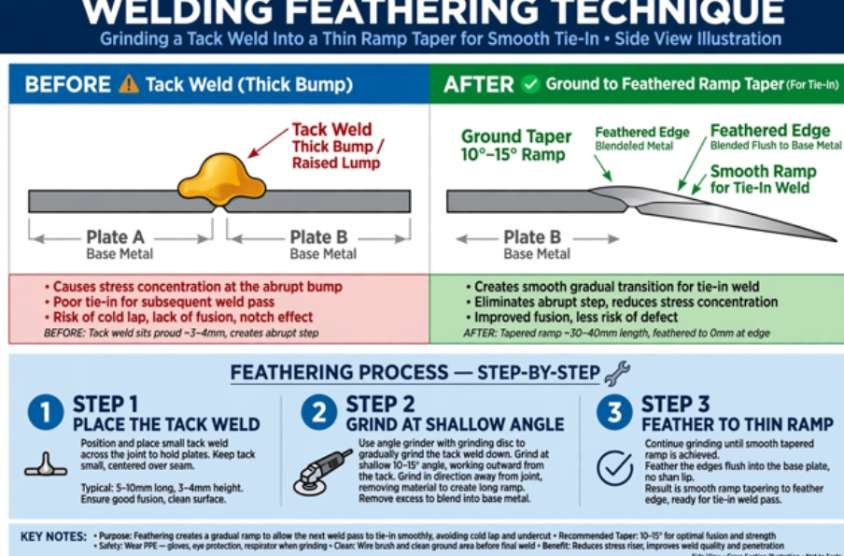
This is my exact process for pipe and plate.
My 3-Step Grind Method
First, I tack the joint to hold my gap. Four tacks on pipe, two on plate. Then I grab a 4.5″ grinder with a thin 1/16″ cutting wheel.
Step one: grind the leading edge of the tack. I come in at about 20-25 degrees and create a long taper. You want to see the feather go from full tack thickness down to almost paper-thin where it meets the root face. Don’t grind it to zero — leave about 1/16″ at the tip or the tack will break and your gap will close.
Step two: clean the groove walls. I lightly kiss the side walls but never gouge them. A gouge traps slag. YesWelder’s guide on TIG root techniques stresses wall cleanliness for this exact reason.
Step three: tie-in. I start my arc about 1/4″ behind the feathered ramp to preheat it. As soon as the puddle wets in, I walk or whip forward onto the ramp. The thin edge melts instantly, and the puddle drops right into the gap. You will feel it sink.
| Grinding Tool | Best For | My Tip |
| Thin Cut-off Wheel (0.045″) | Precise feathering | Gives sharpest ramp, less heat |
| Grinding Disc (1/8″) | Heavy tacks on stick | Faster but easy to over-grind |
| Carbide Burr | Pipe internal tie-ins | Great control in tight V |
Once you master open roots, your next skill progression is fillet weld multi pass stacking technique for structural joints where tie-ins stack differently.
Common Defects I See When Welders Skip Feathering
I see three failures weekly in our shop when guys skip this.
Internal porosity forms when the arc jumps the bump and traps gas underneath. Cold lap appears as a line on the cap that never fused to the sidewall. On X-ray, lack-of-fusion at tack points looks like a straight dark line. All three come from one thing: welding over a thick, cold lump.
A feathered tie-in eliminates that cold mass.
Pro Tips From My Bench
Keep your feather length at least 3x the bead width. A short steep ramp still acts like a bump. A long gentle ramp is invisible after welding.
On 2″ Schedule 80 pipe, I feather both the front and back of each tack. That way I can weld in either direction.
Finally, check your gap after feathering. Grinding vibration closes gaps. I keep a 3/32″ filler rod as a go/no-go gauge.
Frequently Asked Questions
1. What root gap is best for open root butt joint with 6010?
I run 3/32″ to 1/8″ gap with a 1/16″ land for 6010 open roots.
2. Can I use feather edge instead of root face on pipe?
Yes on thin wall under 0.120″ with TIG, but use a land on thicker pipe to prevent blow-through.
3. How thin should feathering be for tie-in?
Grind to about 1/16″ thin at the tip, tapered over 1/2″ length.
4. Why does my open root have lack of fusion at tacks?
Your tack wasn’t feathered — the arc couldn’t melt the thick stop, leaving an unfused ramp.
Final Spark
Butt joint bevel root gap feathering technique is not extra credit. It is the difference between a root that passes bend test and one that cracks. Bevel correctly, hold your gap, and never weld over a lump you didn’t grind into a feather.
Go grind a few practice tacks and you will hear the difference when the puddle sinks instead of sitting on top.